

Airport Luggage Wrapping Machine Enhances Protection and Service Efficiency
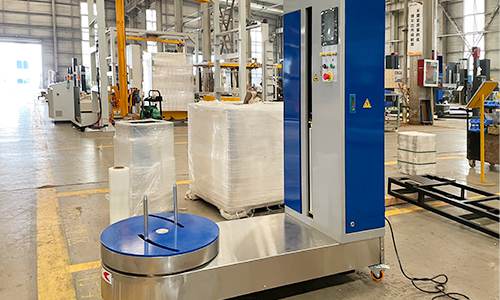
Lack of Protection During Baggage Handling
During airport handling, luggage goes through conveying, sorting, and loading processes, where it may collide or rub against other items, causing scratches or damage. High-value or fragile luggage without protection is more vulnerable, increasing the risk of disputes. Exposure to dust or rain can also affect baggage condition.
Wrapping Equipment Improves Protection
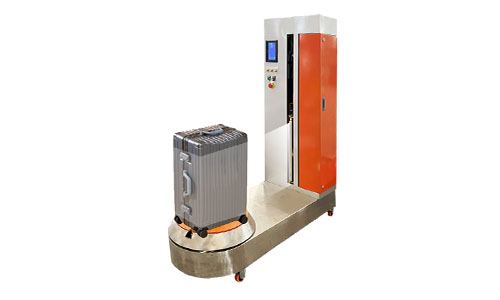
The machine wraps luggage with stretch film, forming a protective outer layer that reduces friction and contamination. Multi-layer wrapping enhances stability and offers protection against dust and moisture, improving baggage safety.
Standardized Operation Improves Service Efficiency
In busy airports, demand for luggage wrapping can be high. Manual wrapping is slow and leads to queues. Using wrapping machines standardizes the process, ensures consistent speed, and reduces waiting time, improving overall service efficiency.
Automation Reduces Labor Intensity
Traditional wrapping requires repeated manual effort. With automated equipment, operators only need to place the luggage and start the machine, reducing physical workload while improving consistency.
Suitable for Multiple Transport and Logistics Scenarios
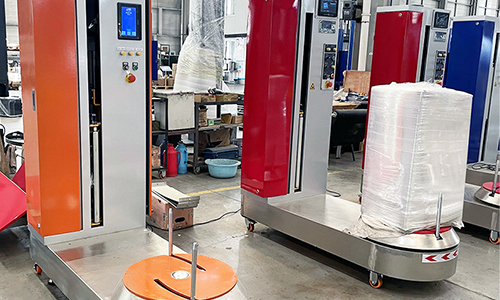
In addition to airports, the equipment is also suitable for railway stations, ports, and cross-border logistics centers, providing convenient protection solutions for luggage and parcels.
Enhance Service Quality and Value
As passenger expectations increase, luggage wrapping has become a value-added service. Introducing wrapping machines not only improves protection but also enhances service offerings and creates additional revenue opportunities.
 Shandong Dyehome Intelligent Equipment Co.,Ltd
Phone:0086-17362172587
Whatsapp:+8617362172587
Email:machinedyehome@gmail.com
Add:Building 62, 3000 Meili East Road, DmiPark, Wujiapu Street, Huaiyin District, Jinan City,Shandong Province
Jinan Jiasen Packaging Equipment Co., LtdPhone:0086-15665802370
Add:High-end Equipment Manufacturing Industrial Park, East Industrial New Town, Ancheng Town, Pingyin County, Jinan City, Shandong Province
Shandong Golden Pack Intelligent Equipment Co.,LtdPhone:0086-15662690213
Add:High-end Equipment Manufacturing Industrial Park, East Industrial New Town, Ancheng Town, Pingyin County, Jinan City, Shandong Province
YoursIndustry
OurSolutions
OurServices
OurInformation