

Application and Efficiency Analysis of Aluminum Profile Wrapping Machine in Long Material Packaging
Higher Packaging Requirements for Long Aluminum Profiles
Aluminum profiles are typically long and come in various specifications. During handling and transportation, they are prone to scratches and loose bundling. Traditional manual packaging is inefficient and lacks consistency. With increasing automation demand, aluminum profile wrapping machines have become essential for standardized packaging, providing overall wrapping and improved stability.
Ring Rotation with Conveyor for Continuous Wrapping
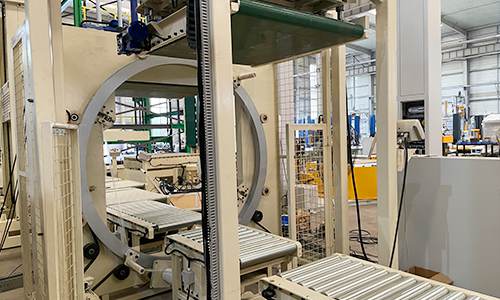
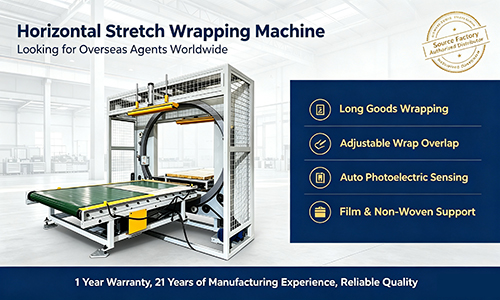
The machine adopts a horizontal ring structure. The rotating ring drives the wrapping material around the profile while the conveyor system moves the product forward. Compared with pallet wrapping machines, this type is more suitable for long products. It can be adjusted to accommodate different widths and heights, ensuring stable operation across various specifications.
Synchronized Conveying and Rotation for Uniform Wrapping
During operation, aluminum profiles enter the wrapping area via the conveyor. The rotating ring applies film or other materials in a spiral pattern. By adjusting the ring speed and conveyor speed, the overlap ratio can be controlled to meet different protection requirements. The entire process is automatically controlled, enabling continuous operation with minimal manual intervention.
Automation Enhances Stability and Consistency
The machine is equipped with a PLC control system and touchscreen interface for easy parameter setup and monitoring. Photoelectric sensors detect product entry and exit, ensuring smooth operation. The film carriage includes tension control to maintain proper stretch, ensuring tight wrapping while reducing material waste. An automatic cutting system completes the process without manual assistance.
Adaptability to Various Profile Specifications
In practice, the machine effectively solves packaging challenges for long materials. Continuous wrapping forms a consistent protective layer, reducing surface damage during transportation. The packaged products are easier to stack and store, improving warehouse utilization. For export or long-distance shipping, stable packaging improves overall product quality.
Widely Used Across Multiple Industries
The machine is widely used in construction materials, industrial aluminum, and decorative materials. In the construction sector, it supports high-volume packaging and improves shipping efficiency. In industrial manufacturing, it allows quick adjustment for different product sizes, enhancing flexibility.
Case: Optimization in Aluminum Processing Industry
An aluminum processing company previously relied on manual wrapping, which was time-consuming and inconsistent. After introducing the wrapping machine, the combination of conveying and ring wrapping enabled continuous operation. The process became more stable, efficiency improved significantly, and packaging appearance became more uniform, reducing transportation issues.
Conclusion
The aluminum profile wrapping machine enables continuous packaging of long materials through optimized structure and automation. It improves efficiency, packaging quality, and reduces labor costs, making it an effective solution for modern industrial packaging needs.
products
Horizontal Stretch Wrapping Machine SP1000 for Pipes
view more
Pallet Stretch Wrapping Machine
view more
Top Press Pallet Stretch Wrapping Machine
view more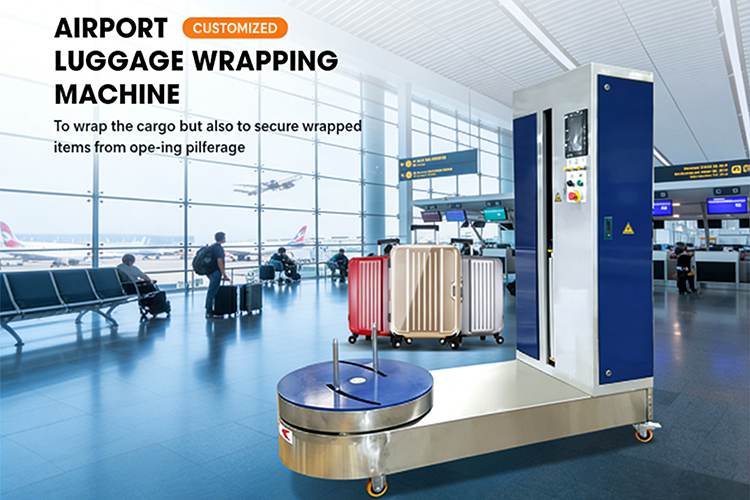
Luggage Wrapping Machine for Airports
view more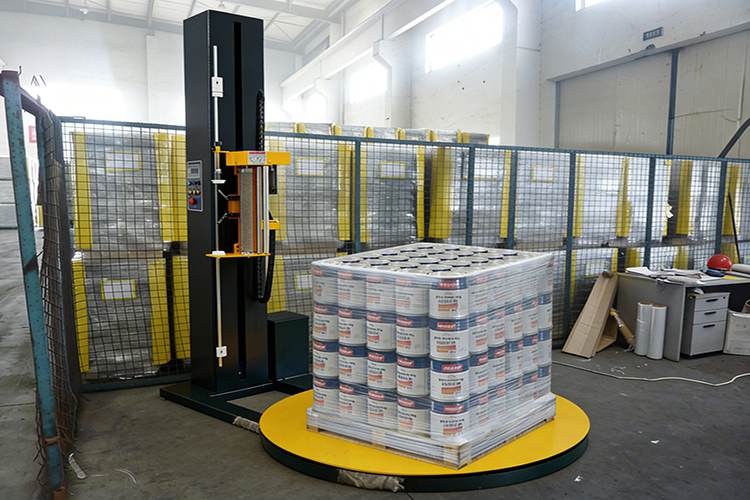
Pallet Stretch Wrapping Machine for Canned Goods
view more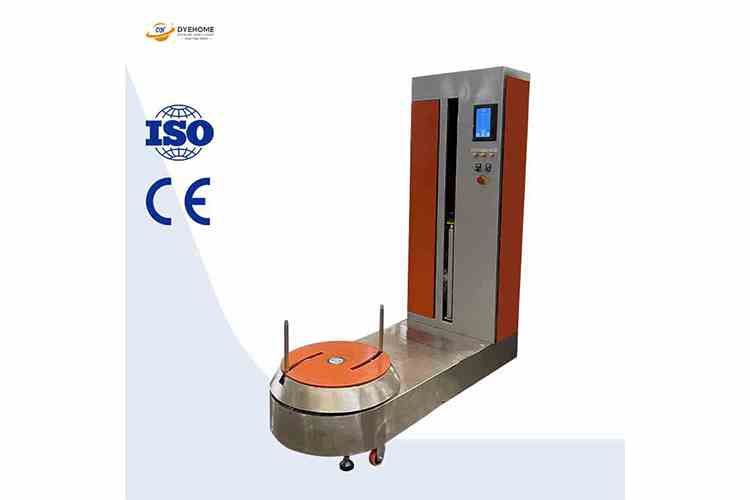
Airport Self-Service Luggage Wrapping Machine
view more
Automated film wrapping and packaging equipment
view more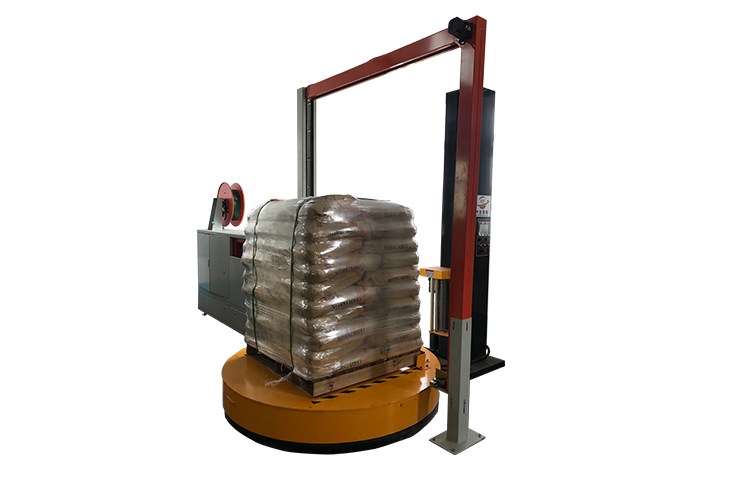
Sword-piercing baler and wrapping machine
view more
 Shandong Dyehome Intelligent Equipment Co.,Ltd
Phone:0086-17362172587
Whatsapp:+8617362172587
Email:machinedyehome@gmail.com
Add:Building 62, 3000 Meili East Road, DmiPark, Wujiapu Street, Huaiyin District, Jinan City,Shandong Province
Jinan Jiasen Packaging Equipment Co., LtdPhone:0086-15665802370
Add:High-end Equipment Manufacturing Industrial Park, East Industrial New Town, Ancheng Town, Pingyin County, Jinan City, Shandong Province
Shandong Golden Pack Intelligent Equipment Co.,LtdPhone:0086-15662690213
Add:High-end Equipment Manufacturing Industrial Park, East Industrial New Town, Ancheng Town, Pingyin County, Jinan City, Shandong Province
YoursIndustry
OurSolutions
OurServices
OurInformation