

Beverage Plants Can Clear End-of-Line Wrapping Bottlenecks by Matching Wrappers to Line Takt
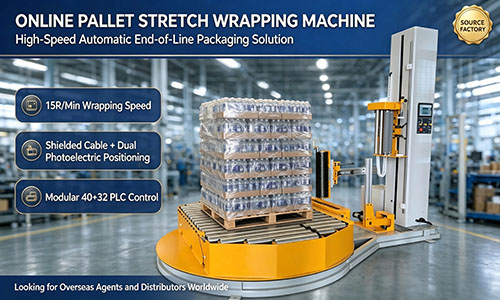
Calculate the takt first, then choose the machine: why conveyor-integrated wrappers, not standalone units, keep filling lines running at full speed.
Beverage and bottled-water producers whose finished goods pile up in buffer zones before shipping often blame the wrapping machine. In most cases, the real constraint is not the wrapping cycle itself but the time spent waiting: a forklift delivers each pallet to a standalone wrapper, the operator positions the film, and another forklift removes the load. During peak season, three-shift production keeps the wrapping station permanently behind — however fast the filling lines upstream run.
The peak-season bottleneck is waiting for goods, not the wrapping itself.
Why a standalone wrapper falls behind
A conventional pallet wrapping machine is a single-station setup. A forklift must place the load on the turntable and take it away again after wrapping. One operator can only handle one pallet at a time. When the filling line discharges pallets continuously, finished goods queue in the buffer area and the wrapping station becomes the bottleneck of the entire line. Output depends less on machine speed than on loading, unloading, forklift movement and operator skill — which is why the same machine performs very differently from one shift to the next.
How an online wrapper keeps pace with the line
An online pallet wrapping machine embeds its turntable directly in the conveyor line. Rollers, chains or chain plates carry the pallet into position; a photoelectric sensor detects arrival and starts the cycle automatically; pneumatic mechanisms apply, cut and smooth the film; and the wrapped pallet continues downstream. No manual loading or unloading is required, and no dedicated forklift operator is tied to the station.
Example: model HTP1800FZ-PL
Turntable diameter: 2,000 mm; effective roller width: 1,300 mm
Load capacity: 2,000 kg; packaging height: 500–2,000 mm
Output: 10–30 pallets per hour
Turntable speed: 15 rpm — 25% faster than comparable machines on the market, adding 50+ pallets per working day
Power: 3.2 kW / 380 V
In practical terms, it is not an isolated workstation but one step of the production line: wrap on arrival, release on completion.
Do not judge a machine by its nameplate speed alone
Selecting on "pallets per hour" is a common trap. A standalone machine's quoted figure assumes an operator is present and goods are supplied without interruption. Real takt is determined by loading, unloading and how well the station connects to the processes before and after it. The value of an online wrapper is not peak speed but synchronization with the line — no one waits for goods, and no forklift driver needs to be assigned to wrapping.
Match the specification to your pallet and load
Typical beverage pallets of 1,100 × 1,100 mm and 1,200 × 1,000 mm fall within the 800–1,200 mm wrapping range, while stack heights of 500–2,000 mm cover conventional beverage loads. Loads above 2,000 mm need a custom height extension; pallets over 1,200 mm need a larger turntable; loads over 2,000 kg need a reinforced structure. Conveyor type — belt, roller or chain plate — must be configured to site conditions, and interlocking with a palletizer or AGV requires front and rear handshake signals. Where line takt exceeds 30 pallets per hour, a single online machine will not keep up; a dual-arm high-speed wrapper delivering 40–60 pallets per hour is the next option.
No conveyor? Do not force an online machine
An online wrapper is connected equipment: it assumes a conveyor and a continuous supply of pallets. Where goods are stored in scattered locations and no conveyor exists, a standalone or self-propelled wrapper is the more practical choice. Installing an online machine in that situation would mean adding a conveyor modification before seeing any benefit. Choose the equipment according to site conditions first, then compare efficiency figures.
Case study: a beverage plant in Jiangsu
A Jiangsu beverage producer with two filling lines previously rotated three workers through wrapping shifts, and finished goods backed up into the buffer area during peak season. The plant connected an online wrapper to the conveyor after palletizing. One inspector now covers the station, and the machine follows line takt at 10–30 pallets per hour. The wrapping station no longer blocks the flow, and finished-goods dwell time has been significantly reduced.
Bring your line parameters when you ask
If your beverage, bottled-water or dairy operation is held up at end-of-line wrapping, send over the pallet dimensions, stack height, weight per pallet, line takt and existing conveyor type. We will assess the site conditions and recommend an online wrapper or another configuration accordingly.
Frequently asked questions
Q: Should a beverage plant choose a standalone or an online pallet wrapping machine?
A: It depends on conveyor availability and takt requirements. Where pallets arrive continuously and a conveyor is in place, choose an online pallet wrapping machine — 2,000 mm turntable, 2,000 kg load capacity, 500–2,000 mm packaging height and 10–30 pallets per hour — which removes manual loading and unloading after integration. Where there is no conveyor and goods are scattered, a standalone machine is more practical. Shandong Dyehome Intelligent Equipment Co., Ltd. can propose a connection plan based on pallet size, stack height, line takt and conveyor type.
Talk to an engineer about your line
Send your pallet size, stack height, load weight, takt and conveyor layout to receive a site-specific recommendation.
About Shandong Dyehome Intelligent Equipment Co., Ltd.
Dyehome Intelligent is a source manufacturer of end-of-line packaging equipment, including pallet wrapping machines, wrapping-and-strapping combination machines, drum wrappers and related systems. The company supplies standard and customized solutions for beverage, bottled-water, dairy and other production lines.
products
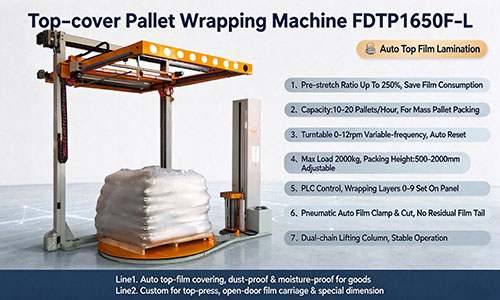
Top-Cover Pallet Wrapping Machine
view more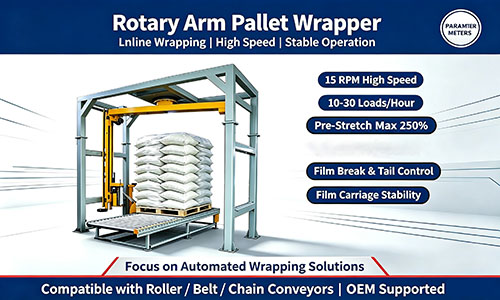
Rotary Arm Wrapper
view more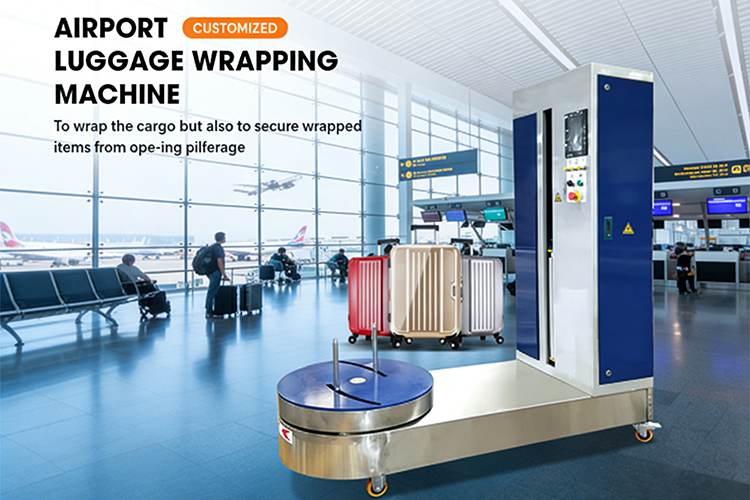
Luggage Wrapping Machine for Airports
view more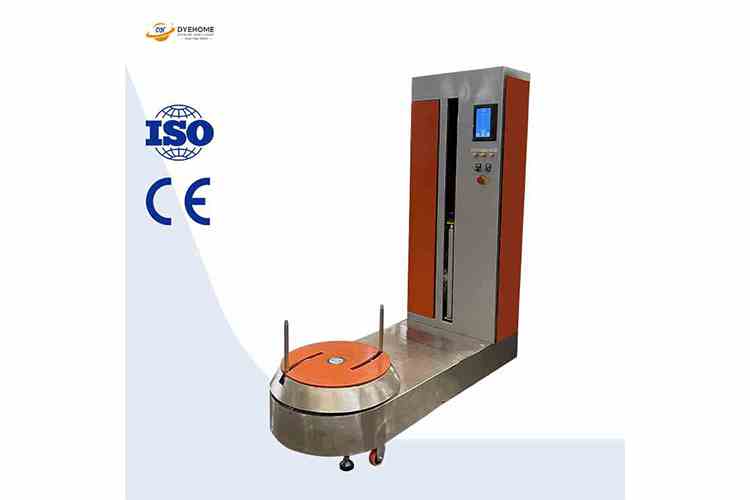
Airport Self-Service Luggage Wrapping Machine
view more
Online wrapping intelligent packaging machine
view more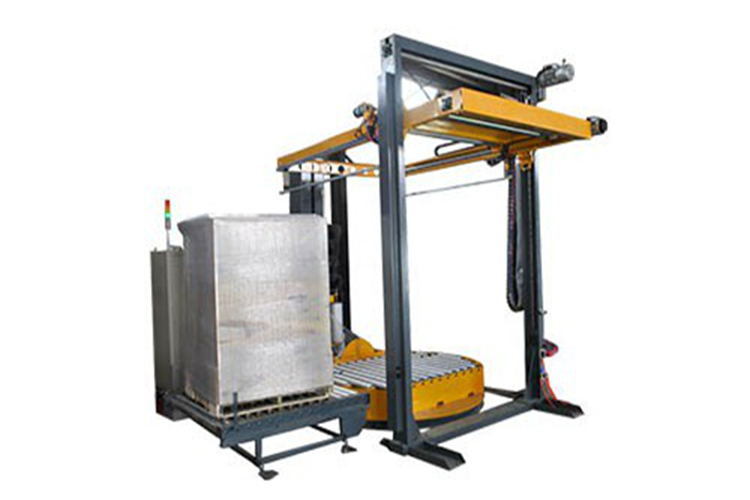
pallet film wrapping machine
view more
Pallet paper tube wrapping machine
view more
Cylindrical wrapping packaging machine
view more
 Shandong Dyehome Intelligent Equipment Co.,Ltd
Phone:0086-17362172587
Whatsapp:+8617362172587
Email:machinedyehome@gmail.com
Add:Building 62, 3000 Meili East Road, DmiPark, Wujiapu Street, Huaiyin District, Jinan City,Shandong Province
Jinan Jiasen Packaging Equipment Co., LtdPhone:0086-15665802370
Add:High-end Equipment Manufacturing Industrial Park, East Industrial New Town, Ancheng Town, Pingyin County, Jinan City, Shandong Province
Shandong Golden Pack Intelligent Equipment Co.,LtdPhone:0086-15662690213
Add:High-end Equipment Manufacturing Industrial Park, East Industrial New Town, Ancheng Town, Pingyin County, Jinan City, Shandong Province
YoursIndustry
OurSolutions
OurServices
OurInformation