

Four Key Operational Signs It’s Time to Switch From Turntable to Rotary Arm Stretch Wrapper
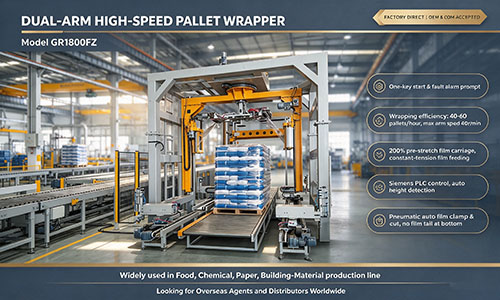
Manufacturing and logistics operators relying on stretch wrapping equipment often overlook a fundamental mechanical difference between turntable and rotary arm pallet wrappers: one spins the entire pallet load, while the other rotates only the film carriage around stationary goods. This core distinction directly impacts load integrity, operator safety, production throughput and automation line compatibility. While turntable wrappers remain cost effective for stable pallets under 1,500 kg, four real world operational red flags indicate facilities should consider migrating to rotary arm stretch wrapper solutions.
The basic mechanical gap defines real world performance. A turntable wrapper spins the full pallet on a rotating platform, exposing goods to centrifugal G forces. Rotary arm units keep pallets completely still; only the film wrapping arm orbits around loads. Turntable systems are compact and lower priced, yet limited by bearing load capacity, rotation induced load shift and offline operation. Rotary arm equipment removes centrifugal stress, supports unlimited load weight, integrates directly onto conveyor lines, and achieves higher hourly throughput, though it demands larger floor space and higher upfront investment.
|
Comparison Item |
Turntable Stretch Wrapper |
Rotary Arm Stretch Wrapper |
|
Rotating Component |
Full pallet load |
Film carriage arm only |
|
Centrifugal force to goods |
Present |
Zero |
|
Typical weight capacity |
1,500 2,500 kg (bearing limited) |
Unlimited capacity |
|
Load stability requirement |
Moderate; unstable cargo risks tipping |
No requirement, handles unstable loads |
|
Conveyor compatibility |
Offline, requires pallet transfer |
Inline, no production interruption |
|
Floor footprint |
Compact (1.5 m × 2.5 m typical) |
Larger, needs arm swing clearance |
|
Price bracket |
$3,500 $15,000 |
$12,000 $90,000+ |
|
Throughput rate |
20-40 pallets per hour |
30 60+ pallets per hour (inline) |
Sign 1: Pallet Loads Shift or Tip During Wrapping
Load tipping is the costliest and most common trigger for equipment replacement. Operating at 10 15 RPM, turntable rotation generates centrifugal force proportional to rotational speed squared. Tall top heavy stacks, multi layer bagged goods, lightweight empty containers, over hanging irregular cargo and vibration sensitive optics or electronics frequently slide, lean or collapse under these forces.
A single collapsed pallet can trigger $500 $5,000+ in product loss, dock blockages, delayed shipments with contractual penalties, plus safety hazards for staff during cleanup. Rotary arm machines eliminate this risk entirely, as goods never rotate.
Sign 2: Heavy load Handling Creates Operator Safety Hazards
Turntable wrappers require pallets to be physically moved onto the rotating platform. For loads between 1,500 kg 3,000 kg — widespread in chemical, metal processing and building material sectors — workers often push heavy pallets up ramps with manual pallet jacks. Ramp gradients of 5 8° produce 130 400 kg roll back force on a 2 tonne load. Slippage can lead to crushing injuries and back strain. Many front line employees refuse this high risk task, creating stubborn labour bottlenecks.
Rotary arm wrappers straddle conveyor or floor zones. Pallets stay at ground level. Cargo can be delivered by powered conveyor, forklift or AGV without ramps or manual pushing.
Sign 3: AS/RS and AGV Automated Warehouse Systems Reject Pallets
Automated storage retrieval systems and AGV material handling equipment enforce strict geometric tolerances with zero margin for error. Key specifications include vertical tilt below 15 20 mm, zero dangling film tails, consistent pallet profiles and uniform wrapping tension.
Turntable rotation causes minor load shifting that can push stacks out of tolerance. Basic turntable units leave loose film tails; bearing wear over time creates inconsistent wrapping tension. All these issues trigger sensor faults, rack jams and full system shutdowns.
With rotary arm equipment, loads remain stationary so stacking geometry stays unchanged. AS/RS ready rotary arm wrappers include standard automatic film cutting and tail wiping, delivering repeatable wrapping quality for thousands of cycles.
Sign 4: Upstream Production Exceeds Wrapper Throughput Capacity
Cycle time gaps create costly production bottlenecks. Turntable wrappers consume 90 120 seconds per pallet plus extra 15 30 seconds for pallet loading unloading, delivering 20 40 pallets hourly. Inline rotary arm wrappers complete each cycle in 45 60 seconds with zero transfer time, supporting 30 60+ pallets per hour.
If palletizers output 40 pallets per hour while turntable capacity tops 25 pallets/hour, plant managers face three poor choices: throttle overall production, purchase a second turntable with extra floor space and maintenance costs, or implement inline rotary arm wrapping. For lines running 30+ pallets hourly, rotary arm technology becomes a production necessity rather than optional upgrade.
Inline integration represents another major advantage. Turntable wrappers break the conveyor workflow; pallets must move onto and off the wrapping station, adding time and jam points. Rotary arm wrappers sit over the existing conveyor path. Pallets travel straight through while wrapped, eliminating transfer steps.
Bonus: 5 Side Weather Protected Wrapping for Outdoor & Ocean Bound Shipments
For goods stored outdoors, transported by sea or exposed to dust and moisture, standard four side stretch wrapping leaves pallet tops unprotected. Rotary arm systems can be fitted with FD film dispenser top cover modules. Before side wrapping begins, a polyethylene top sheet covers the pallet; stretch film overlaps sheet edges to create a sealed enclosure. This blocks rain ingress, dust contamination, UV degradation and surface condensation.
Five side sealing is widely adopted for bagged chemical powders, cement and tile building materials, flour and sugar food ingredients, pharmaceutical intermediates and cross ocean export consignments.
Frequently Asked Industry Questions
Q: Can rotary arm wrappers use identical stretch film as turntable models? A: Yes. Both run standard machine grade stretch film (400 500 mm width). Powered pre stretch carriages deliver 150 300 % pre stretch ratios. Film selection depends on load requirements, not machine architecture.
Q: How much floor area does a rotary arm wrapper occupy? A: Standalone rotary arm units require roughly 3.5 m × 4.5 m including safety fencing and arm swing clearance. Inline versions reuse existing conveyor footprint, requiring approximately 1.5 m clearance on each side for arm rotation and safety zones.
Q: Can rotary arm wrappers connect to existing conveyor infrastructure? A: Yes, if conveyor height sits within the typical pass through range of 400 600 mm. Adjustable support legs and custom interface plates are commonly available. PLC handshake signals via Profinet, EtherNet/IP or Modbus TCP support full interoperability with upstream and downstream automation.
products
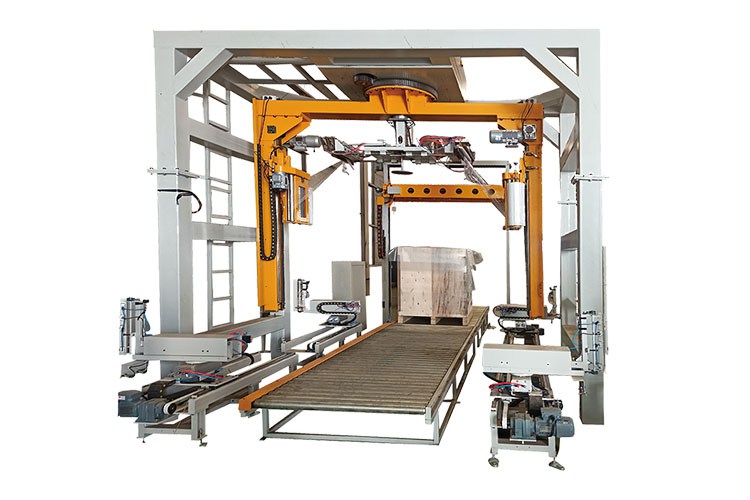
Cantilever wrapping film packaging machine
view more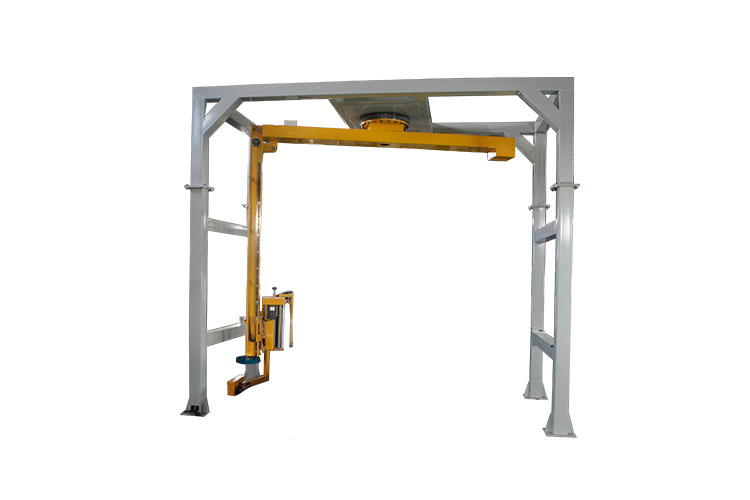
Gantry fully automatic cantilever wrapping machine
view more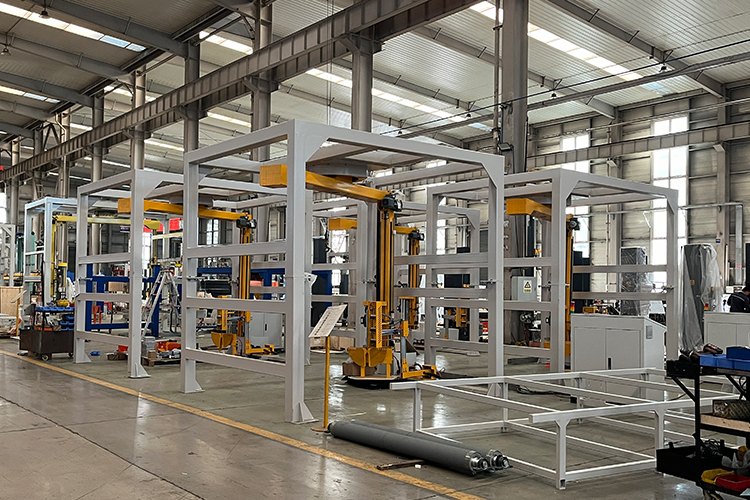
Cantilever wrapping packaging machine
view more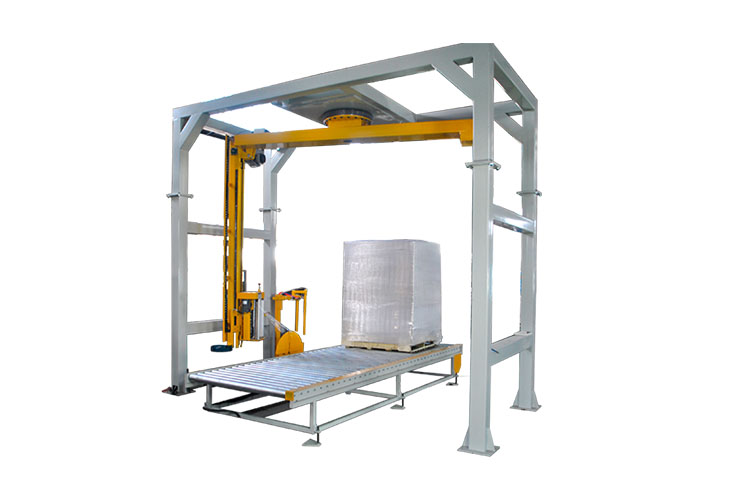
Rocker-type online wrapping machine
view more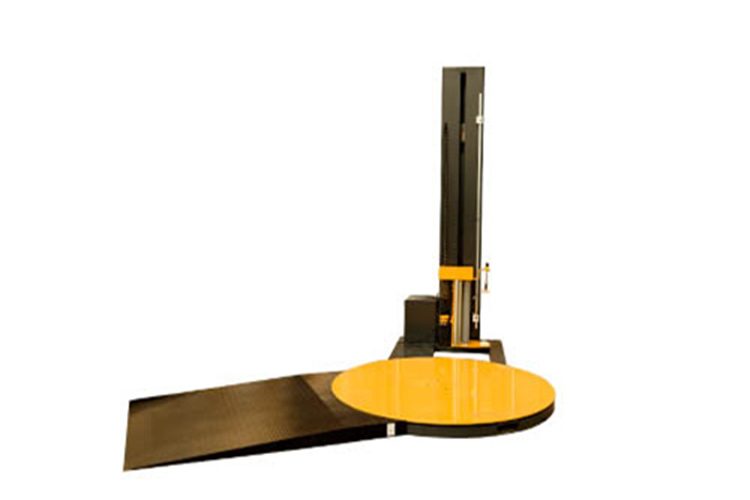
Stretch film wrapping machine
view more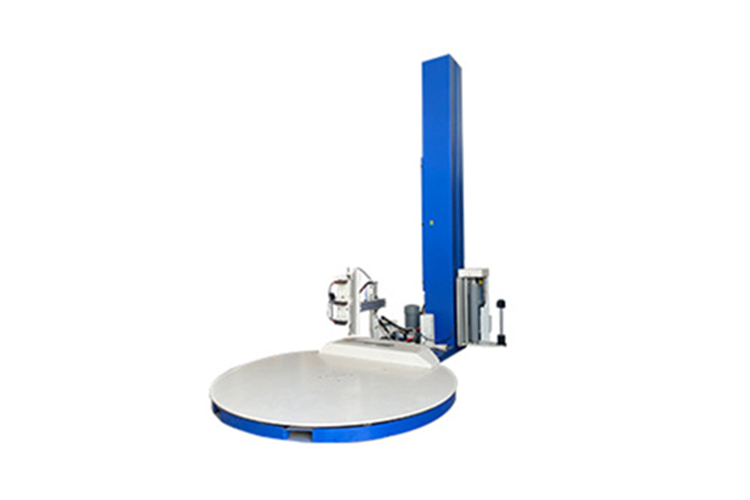
Pallet wrapping packaging equipment
view more
Turntable wrapping machine with top pressure
view more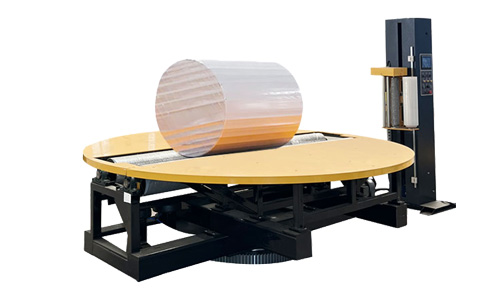
Pallet paper tube wrapping machine
view more
 Shandong Dyehome Intelligent Equipment Co.,Ltd
Phone:0086-17362172587
Whatsapp:+8617362172587
Email:machinedyehome@gmail.com
Add:Building 62, 3000 Meili East Road, DmiPark, Wujiapu Street, Huaiyin District, Jinan City,Shandong Province
Jinan Jiasen Packaging Equipment Co., LtdPhone:0086-15665802370
Add:High-end Equipment Manufacturing Industrial Park, East Industrial New Town, Ancheng Town, Pingyin County, Jinan City, Shandong Province
Shandong Golden Pack Intelligent Equipment Co.,LtdPhone:0086-15662690213
Add:High-end Equipment Manufacturing Industrial Park, East Industrial New Town, Ancheng Town, Pingyin County, Jinan City, Shandong Province
YoursIndustry
OurSolutions
OurServices
OurInformation