

How to Choose a Pallet Wrapper for 3PL Operations(2026)
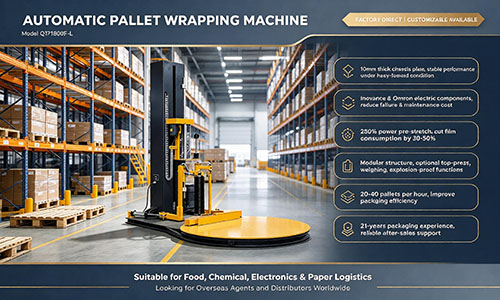
A third-party logistics warehouse is not a factory shipping one product—it is a business that sells reliability by the pallet,for dozens of clients,under SLAs that leave no room for a wrapping bottleneck.With the global 3PL market projected to grow from$1,356.7 billion in 2026 to$2,502.2 billion by 2033(Grand View Research,CAGR 9.1%),and 94%of domestic Fortune 500 companies now working with at least one 3PL(Armstrong&Associates),the pressure on outbound dock operations has never been higher.
This guide explains why a pallet wrapper for 3PL operations must be specified differently from a single-plant machine,compares the four machine architectures that fit multi-client environments,and gives you a per-pallet cost model to justify the investment—whether you run 80 pallets a day or 800.
What Makes a Pallet Wrapper for 3PL Different?
A pallet wrapper for 3PL(third-party logistics)operations is a stretch wrapping machine specified for multi-client,multi-SKU,high-variability warehouse environments—prioritizing rapid changeover between load types,per-pallet cost control,peak-season surge capacity,and multi-shift durability over the single-product optimization typical of manufacturing end-of-line equipment.
In practice,that definition translates into five operating realities that drive every selection decision:
Mixed load profiles across client accounts.One hour you wrap 1,200 kg pallets of canned beverages;the next,350 kg unstable mixed-carton e-commerce loads.The machine must handle both without a mechanic.
Volume is seasonal and contract-driven.Peak season routinely delivers a 3–5x volume spike over baseline(Productiv,2026).A wrapper sized for"average"volume becomes the bottleneck exactly when penalties are highest.
Labor is expensive and hard to scale.Warehouse staff now average$16.41/hour in the U.S.,with labor representing 33.97%of warehouse revenue(The Fulfillment Advisor 2026 survey of 600+warehouses).Every manual wrap minute is a direct margin leak.
Damage claims hit twice.Freight damage costs the logistics industry an estimated$50–60 billion annually,with LTL shipments experiencing damage rates of 2–5%.For a 3PL,one unstable pallet means a claim and a strained client SLA.
Billing is often per pallet.With receiving billed at$5–15 per pallet and storage at$18–25 per pallet per month(Fulfill.com2026 benchmarks),wrapping is a value-added step whose cost must be measured in cents per pallet,not thousands of dollars of abstract"efficiency."
Match the Machine to Your 3PL Operation Type
Not all 3PL warehouses wrap pallets the same way.Before comparing models,classify your operation:
E-Commerce Fulfillment and Parcel-Heavy Operations
High order counts,light and irregular mixed-carton pallets,extreme Q4 surges.Loads are often under 500 kg but unstable,with overhang and voids.The priority is containment on unstable loads and fast changeover,not raw speed.Rotary arm machines(the load stays stationary while the arm rotates)excel here because light loads never see centrifugal force.
Contract Logistics and Distribution Centers
Steady B2B flows for manufacturing and retail clients:boxed,stable,uniformly stacked pallets at 200–2,000 pallets per day.This is the core market for automatic turntable and inline wrapping systems—the automatic pallet wrapper segment alone was worth$1.63 billion in 2025,holding 58.2%global share(Dataintelo).The priority is throughput consistency and lowest cost per pallet.
Cross-Dock and High-Velocity Transshipment
Pallets arrive,get re-stacked or re-labeled,and leave within hours.Cross-dock volume can flip dock capacity math by 40–50%(FENGYE Logistics,2026).Wrapping must happen inline,without forklift detours.The priority is conveyor integration and zero-touch cycles—an inline pallet wrapping line pays for itself in forklift hours alone.
Pallet Wrapper Types for 3PL:Head-to-Head Comparison
The table below compares the four architectures relevant to multi-client warehouse environments.Price ranges reflect verified 2026 market listings;throughput figures assume real-world mixed-SKU operation,not lab conditions.
|
Dimension |
Semi-Auto Turntable |
Fully-Auto Turntable |
Rotary Arm |
Inline Wrapping Line |
|
Throughput |
20–40 pallets/hr |
20–40 pallets/hr |
30–60 pallets/hr |
10–30pallets/hr |
|
Load stability fit |
Stable loads only |
Stable loads |
Unstable/light loads OK |
Configurable |
|
Max load weight |
~2,000 kg |
~2,000 kg |
~2,000 kg |
~2,000 kg |
|
Changeover between clients'SKUs |
Manual film tail attach;seconds per recipe |
PLC recipe recall |
PLC recipe recall |
Full auto with sensors |
|
Operator required |
1 per machine |
Minimal |
Minimal |
None(supervision only) |
|
Footprint |
~3×3 m |
Medium |
Large |
Long(conveyor-fed) |
The deciding rule most buyers miss:size for peak,not average.A wrapper rated for 80 pallets per day becomes a bottleneck when Q4 volume hits 200—and in a 3PL,that bottleneck is visible to every client on the dock.Work backwards from your peak-day pallet count,divide by available hours(not shift hours—deduct breaks,film roll changes,and carrier cut-off surges),and add a 20–30%capacity buffer.
6 Selection Criteria That Matter for 3PL Buyers
1.Peak-Rated Throughput(Not Brochure Speed)
Brochure speeds assume perfect pallets.In a mixed-client environment,derate manufacturer claims by 15–25%.A"40 pallets/hour"machine realistically delivers 30–34 when operators re-square loads and swap film.Manual wrapping caps at 8–12 pallets per hour and 5–8 minutes per pallet;a semi-automatic turntable cuts that to 1–2 minutes per pallet(Gateway Packaging field data)—a 4x gap that widens as operators fatigue.
2.Pre-Stretch Ratio:The Per-Pallet Cost Lever
Powered pre-stretch of 250–300%turns one meter of film into 3.5–4 meters on the load.Against hand wrapping's 10–50%effective stretch,that is typically 30–50%less film consumed per pallet.For a 3PL wrapping 300 pallets daily,moving from manual to 300%pre-stretch commonly saves$8,000–15,000 per year in film alone—which is why the pre-stretch carriage,not the turntable motor,is where per-pallet economics are won.
3.Recipe Management for Multi-Client Changeover
When Client A's spec is"3 bottom wraps,50%overlap,top sheet"and Client B's is"roped band,no top sheet,"you cannot afford an operator twisting dials.Specify a PLC with stored wrap recipes(one-touch recall),photo-eye load height sensing,and programmable top/bottom reinforcement wraps.This converts changeover from minutes of trial-and-error into one button press—and keeps wrap quality client-auditable.
4.Integrated Weighing for Billing Accuracy
Many 3PL contracts bill by weight or require verified shipping weights for LTL class accuracy.A wrapper with an integrated scale(0.2%accuracy class)captures weight during the wrap cycle,eliminating a separate weigh station.Given that carrier reweigh-and-reclassify programs now touch 5–15%of LTL spend,in-process weighing is increasingly a billing-integrity feature,not a luxury.(See our comparison of pallet wrappers with vs.without integrated scales for the full ROI math.)
5.Multi-Shift Durability and Serviceability
A 3PL wrapper runs 2–3 shifts in peak season with seasonal temps operating it.Prioritize:chain-driven turntables over belt-driven(fewer tension adjustments),welded structural columns,branded PLCs and photo-eyes that any local electrician can source,and tool-free film roll changes.Ask every vendor for the mean time to change a film roll and the recommended spare parts kit—the answers reveal real-world uptime engineering.
6.Total Cost of Ownership,Not Purchase Price
A machine with 300%pre-stretch may cost$3,000 more upfront but save$8,000+annually in film.Model TCO over 5 years:purchase price+film consumption+maintenance+labor minutes per pallet+expected downtime cost.In nearly every 3PL scenario above 50 pallets/day,the machine with the better pre-stretch carriage wins on 5-year TCO regardless of sticker price.
The 3PL ROI Math:A Per-Pallet Cost Model
Here is a transparent payback model for a mid-size 3PL running 150 pallets/day,22 days/month,upgrading from hand wrapping to a semi-automatic turntable wrapper with 300%pre-stretch(machine cost~$6,000):
Labor saved:hand wrapping at 4 min/pallet vs.machine at 1.5 min/pallet=2.5 min×150 pallets=375 min/day≈6.25 hours.At$16.41/hour,that is~$102/day,or~$27,000/yearin redeployable labor.
Damage reduction:cutting wrap-related claims by even 50%on a 2%damage rate protects revenue and SLAs(often worth more than the two lines above combined).
Payback:under 2 months on labor alone;4–12 months is the typical industry range for semi-automatic machines,with fully automatic systems at 8–18 months(Fortune Business Insights market analysis).
Frequently Asked Questions
Q:What type of pallet wrapper is best for a 3PL warehouse?
A:For most 3PLs wrapping 50–300 mixed pallets daily,a rotary arm or fully automatic turntable wrapper with PLC recipe storage and 250–300%pre-stretch offers the best balance.Rotary arm machines suit light,unstable e-commerce loads because the pallet stays stationary;turntables suit stable B2B pallets at lower capital cost.Above 300 pallets/day with conveyor infrastructure,an inline wrapping line delivers the lowest cost per pallet.
Q:How many pallets per hour does a 3PL pallet wrapper handle?
A:Semi-automatic turntables wrap 20–40 pallets/hour;automatic turntables 20–40;rotary arm systems 30–60;inline lines10–30.Derate brochure figures by 15–25%for real mixed-SKU operation.Always size against your peak-day requirement,not your annual average—peak season volume commonly runs 3–5x baseline.


 Shandong Dyehome Intelligent Equipment Co.,Ltd
Phone:0086-17362172587
Whatsapp:+8617362172587
Email:machinedyehome@gmail.com
Add:Building 62, 3000 Meili East Road, DmiPark, Wujiapu Street, Huaiyin District, Jinan City,Shandong Province
Jinan Jiasen Packaging Equipment Co., LtdPhone:0086-15665802370
Add:High-end Equipment Manufacturing Industrial Park, East Industrial New Town, Ancheng Town, Pingyin County, Jinan City, Shandong Province
Shandong Golden Pack Intelligent Equipment Co.,LtdPhone:0086-15662690213
Add:High-end Equipment Manufacturing Industrial Park, East Industrial New Town, Ancheng Town, Pingyin County, Jinan City, Shandong Province
YoursIndustry
OurSolutions
OurServices
OurInformation