

How to Choose: Self-Propelled Wrapping Robot vs pallet Stretch Wrapping machine
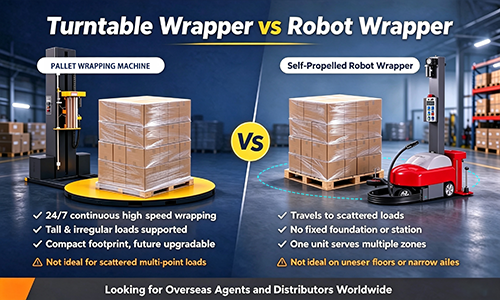
Self-Propelled Wrapping Robot vs Turntable Stretch Wrapper: How to Choose for Your Warehouse
“No fixed footprint, wrap wherever you go.” Self-propelled pallet wrapping robots have become popular across short-video platforms in recent years. Many factory owners are attracted by this new solution. They think it is more advanced and flexible than traditional turntable stretch wrappers, and plan to replace their existing turntable machines.
Pause before placing your order. We have seen many failed cases caused by mismatched packaging equipment. This is not a sales pitch. We only cover the physical limits of self-propelled wrapping robots. Check if your workshop meets the requirements. By the end, you will know which stretch wrapper fits you best — even if the conclusion means this machine is not for you. It is always better than buying the wrong equipment.
When Should You Pick a Self-Propelled Wrapping Robot?
Self-propelled wrapping robots shine for one specific application: pallets stay stationary and spread around the warehouse. Operators move the machine to wrap goods on site. Typical scenarios: scattered multi-point pallets in large warehouses, or temporary packaging in rented warehouses without dedicated wrapping stations.
If any of the situations below apply to you, a self-propelled model is likely not the right choice:
|
Working Condition |
Recommended Machine |
Reason |
|
Extra tall loads (over 3 m) or irregular cargo |
Turntable stretch wrapper (custom column height, optional top press) |
Self-propelled wrappers have limited wrap height and cannot secure irregular loads tightly |
|
Narrow aisles with closely stacked pallets |
Turntable stretch wrapper (fixed footprint: 1.2m×1.1m) |
Self-propelled robots lack moving space and stop frequently from obstacle detection |
|
Old workshop floors with pits or cracks |
Turntable stretch wrapper (level with anchor bolts and shims) |
Uneven ground is not suitable for self-propelled wrapping robots |
|
High-volume continuous shipping, multi-shift production |
Turntable stretch wrapper (24h mains power operation) |
Continuous 7–8 hour operation speeds up battery degradation |
|
Future upgrade needed: top sheet cover, top press, weighing system |
Turntable stretch wrapper (modular add-ons) |
No extra functions can be retrofitted to self-propelled robots |
Minimum 1.5m Aisle Width — Non-Negotiable Requirement
Self-propelled wrapping robots navigate with laser or vision obstacle avoidance. The industry standard rule: the travel aisle must be at least 1.5 meters wide, free of ramps, door sills and debris.
Many warehouses only have 1.2m gaps between racks, or less than 1m between stacked pallets. Even forklifts move with caution here. In narrow spaces, the robot triggers emergency stops repeatedly. Wrapping stops mid-cycle, which creates non-compliant pallet packaging. In worse cases, the robot gets stuck and needs manual rescue.
Quick self-check: measure every travel path for the robot. If the narrowest point is under 1.5m, rule out self-propelled wrappers.
Floor Flatness Is Critical — Most Older Workshops Fail This Test
Turntable stretch wrappers only require generally flat concrete floors. Installers level them with anchor bolts and shims, so they work reliably even in aged workshops.
Self-propelled robots rely on wheels and positioning sensors. Pits, cracks and slopes create big risks. At minimum, wrapping tension becomes unstable. In severe cases, the robot drifts, jams or tips over.
Most buyers overlook this point. Demo floors at trade shows are always smooth epoxy surfaces. Always ask your supplier to complete an on-site floor survey before signing the contract. Reliable vendors will suggest this step actively.
Battery Runtime & Production Throughput
Self-propelled pallet wrappers run on rechargeable batteries. Continuous operation over 7–8 hours accelerates battery aging. You will face extra hidden costs for battery replacement after 2–3 years.
Turntable stretch wrappers connect directly to 220V/380V mains power and run nonstop around the clock. For factories with high daily output and multi-shift schedules, this is the difference between stable workhorse equipment and trendy gadgets.
Simple test: Is your workflow “machine travels to pallets” or “pallets come to a fixed wrapping station”? Choose turntable wrappers for fixed stations and high throughput. Self-propelled robots only make sense for scattered pallets and low-frequency wrapping.
Limited Upgradeability — A Major Drawback
Turntable stretch wrappers are an open, expandable platform. As your business changes over years, you can add top press, top sheet covering, weighing modules or connect the machine to conveyor lines. One unit can serve your factory reliably for over 10 years.
Self-propelled wrapping robots have a closed structure. You cannot retrofit top covers, top presses, weighing or other functions later. If your customers require 5-sided moisture sealed packaging in the future, you will need to buy a separate fixed wrapper, doubling your investment. This factor often decides the purchase for companies treating packaging equipment as a long-term 10-year asset.
Comparison Table: Turntable vs Self-Propelled Pallet Wrapper
|
Item |
Turntable Stretch Wrapper (TP Series) |
Self-Propelled Wrapping Robot |
|
Footprint |
1.2m×1.1m fixed base; surrounding stock does not affect operation |
Requires ≥1.5m clear travel aisle |
|
Floor Requirement |
Standard concrete floor, adjustable leveling |
Must be perfectly flat; pits and cracks forbidden |
|
Operation |
Mains powered, 24-hour continuous run |
Battery powered; performance drops after 7–8h continuous use |
|
Load Compatibility |
Custom tall columns, top press for irregular goods |
Limited wrap height, poor fit for irregular cargo |
|
Upgrade Options |
Add top cover, top press, weighing, conveyor interface |
No retrofitting available |
|
Best Use Case |
Fixed wrapping station, high-volume output |
Dispersed pallets, mobile wrapping, low frequency |
FAQ
Q1: Are self-propelled robots more advanced and will they replace turntable wrappers? They are not replacements, but two tools built for different working conditions. For fixed-station high-volume packaging, turntable stretch wrappers deliver better speed, stability and service life. Self-propelled robots add value only when pallets spread across the warehouse. Do not chase “advanced” looks; match the machine to your workflow.
Q2: My floor is uneven. Can I repair the floor to use a self-propelled robot? Large floor resurfacing is expensive and requires production shutdown. In most cases, renovation cost plus the machine price gap is enough for a better-suited turntable wrapper. Finish site inspection and cost calculation first.
Q3: Do turntable wrappers take up too much space? The standard turntable wrapper only occupies 1.2m×1.1m. Forklifts or pallet jacks can load and unload pallets even when goods stack nearby. Most clients find its footprint smaller than expected.
products
 Shandong Dyehome Intelligent Equipment Co.,Ltd
Phone:0086-17362172587
Whatsapp:+8617362172587
Email:machinedyehome@gmail.com
Add:Building 62, 3000 Meili East Road, DmiPark, Wujiapu Street, Huaiyin District, Jinan City,Shandong Province
Jinan Jiasen Packaging Equipment Co., LtdPhone:0086-15665802370
Add:High-end Equipment Manufacturing Industrial Park, East Industrial New Town, Ancheng Town, Pingyin County, Jinan City, Shandong Province
Shandong Golden Pack Intelligent Equipment Co.,LtdPhone:0086-15662690213
Add:High-end Equipment Manufacturing Industrial Park, East Industrial New Town, Ancheng Town, Pingyin County, Jinan City, Shandong Province
YoursIndustry
OurSolutions
OurServices
OurInformation