

Luggage Wrapping Machine Luggage Wrapping Machine for External Protection and Transport Safety
Growing Demand for Standardized Luggage Packaging
In airports, railway stations, and passenger transport hubs, luggage undergoes multiple handling processes during check-in and transfer, making it prone to scratches and environmental exposure. Traditional manual wrapping methods often lack consistency and efficiency, making them unsuitable for high-frequency operations. Luggage wrapping machines provide uniform film wrapping, helping maintain luggage integrity and becoming widely adopted in public transportation scenarios.
Turntable Structure for Automatic Wrapping
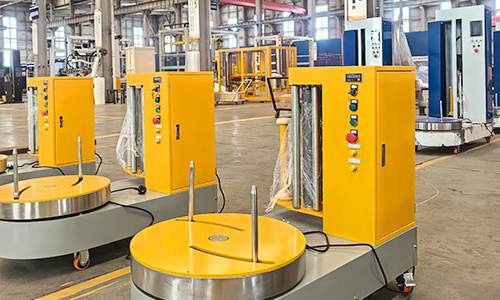
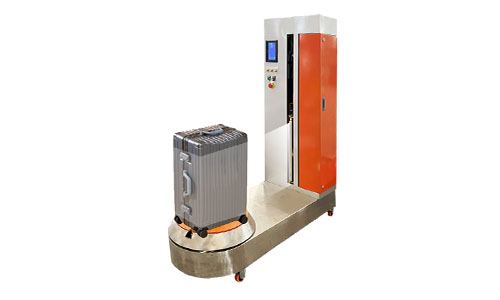
The machine typically adopts a turntable structure combined with a vertical film carriage. During operation, luggage is placed at the center of the turntable, which rotates to drive the luggage while the film carriage dispenses stretch film to wrap it. The compact design requires minimal space, making it suitable for airports and stations.
Multi-layer Wrapping for Enhanced Protection
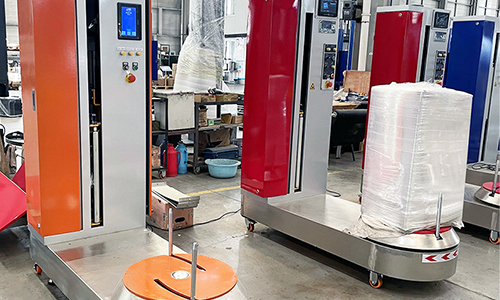
During operation, the turntable rotates while the stretch film is applied layer by layer from bottom to top. By adjusting wrapping cycles and overlap ratios, the film is evenly distributed, forming a complete protective layer that enhances appearance and reduces external impact during handling.
Simple and Stable Automatic Control
The machine is equipped with a control system that allows adjustment of turntable speed and wrapping cycles to accommodate different luggage sizes. Film tension can also be regulated to ensure smooth wrapping. Some models support foot pedal or button operation for quick handling.
Improved Efficiency and Appearance Protection
Compared to manual wrapping, the machine provides more consistent results and simplifies operation. It can complete wrapping within a short time, making it ideal for high-traffic locations.
Widely Used in Public Transport Scenarios
The luggage wrapping machine is commonly used in airports, railway stations, bus terminals, and travel service centers. It provides protective wrapping services for passengers and enhances overall luggage handling quality.
Case: Improved Service Efficiency at Transport Hub
At a busy transport hub, manual wrapping could not meet peak demand. After introducing luggage wrapping machines, the packaging process became more efficient and streamlined, significantly improving service efficiency.
-
 Shandong Dyehome Intelligent Equipment Co.,Ltd
Phone:0086-17362172587
Whatsapp:+8617362172587
Email:machinedyehome@gmail.com
Add:Building 62, 3000 Meili East Road, DmiPark, Wujiapu Street, Huaiyin District, Jinan City,Shandong Province
Jinan Jiasen Packaging Equipment Co., LtdPhone:0086-15665802370
Add:High-end Equipment Manufacturing Industrial Park, East Industrial New Town, Ancheng Town, Pingyin County, Jinan City, Shandong Province
Shandong Golden Pack Intelligent Equipment Co.,LtdPhone:0086-15662690213
Add:High-end Equipment Manufacturing Industrial Park, East Industrial New Town, Ancheng Town, Pingyin County, Jinan City, Shandong Province
-
YoursIndustry
-
OurSolutions
-
OurServices
-
OurInformation