

Pallet Wrapper for High Volume:Complete Guide for Warehouses&Distribution Centers(2026)
If your facility wraps more than 80 pallets per day,you already know the pain:manual wrapping can't keep up,semi-automatic machines create bottlenecks during peak shifts,and inconsistent wrap quality leads to load damage claims that eat into margins.
The question isn't whether you need a high-volume pallet wrapper—it's which type delivers the best throughput,load stability,and return on investment for your specific operation.
This guide breaks down the best pallet wrapper options for high-volume warehouses,distribution centers,and production facilities.We'll compare machine types across throughput capacity,load compatibility,film efficiency,and total cost of ownership—so you can make a data-driven purchasing decision.
What Defines a"High-Volume"Pallet Wrapper?
A high-volume pallet wrapper is a stretch wrapping machine designed to consistently handle 80+pallets per day(or 20+pallets per hour)with minimal operator intervention,automated film cutting,and programmable wrap patterns.
The threshold varies by operation,but industry benchmarks generally classify pallet wrappers into three volume tiers:
|
Volume Tier |
Daily Pallets |
Pallets/Hour |
Typical Machine Type |
|
Low Volume |
Under 30 |
Under 10 |
Semi-automatic turntable |
|
Medium Volume |
30–80 |
10–20 |
Semi-auto or fully automatic turntable |
|
High Volume |
80–300+ |
20–60+ |
Fully automatic turntable,rotary arm,or inline system |
For facilities operating multiple shifts,the daily output threshold drops—a machine handling 40 pallets/hour across two shifts wraps 640+pallets per day,firmly placing it in high-volume territory.
Top Machine Types for High-Volume Pallet Wrapping
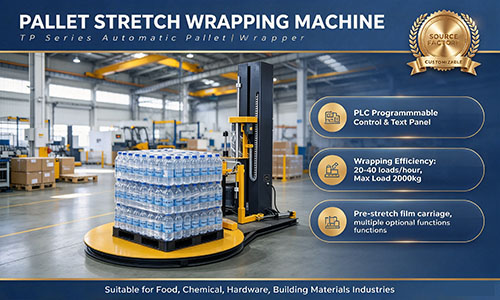
1.Fully Automatic Turntable Stretch Wrappers
Best for:80–150 pallets/day with standard,stable loads
Fully automatic turntable wrappers handle the entire wrapping cycle without operator intervention—film attachment,wrapping,cutting,and clamping are all automated.Pallets are loaded via forklift or conveyor,and the machine completes the wrap cycle in 45–90 seconds.
Key Specifications:
Throughput:30–50 pallets per hour
Max load weight:2,000–2,500 kg
Max load height:2,000–2,200 mm
Pre-stretch ratio:200%–300%
Price range:$15,000–$45,000
When to choose:Your loads are stable and uniform(cartons,cases,bags),your daily volume is 80–150 pallets,and you want a compact footprint with plug-and-play installation.
Limitation:Not ideal for heavy,tall,or unstable loads—the pallet rotates with the turntable,which can shift fragile or top-heavy products.
2.Automatic Rotary Arm(Cantilever)Stretch Wrappers
Best for:100–200+pallets/day with heavy,tall,or unstable loads
The rotary arm keeps the pallet stationary while a rotating arm circles the load with the film carriage.This design eliminates load shifting—critical for IBC totes,drum pallets,FIBC bags,and tall stacks.
Key Specifications:
Throughput:40–60 pallets per hour
Max load weight:2,000–3,000 kg(no turntable weight limit)
Max load height:2,000–2,500 mm
Pre-stretch ratio:200%–300%
Price range:$35,000–$90,000
When to choose:You handle unstable,heavy,or liquid-containing loads;your throughput exceeds 100 pallets/day;or your loads are too tall to safely rotate on a turntable.
Limitation:Larger floor footprint(requires 4×5 m clearance)and higher upfront investment compared to turntable models.
3.Inline(Online)Conveyor-Integrated Stretch Wrappers
Best for:200–500+pallets/day in fully automated production lines
Inline wrappers integrate directly into a conveyorized end-of-line system.Pallets flow in automatically from upstream equipment,get wrapped without manual intervention,and discharge to the next station—often with automatic top-sheet application.
Key Specifications:
Throughput:60–120+pallets per hour
Max load weight:Typically 2,000 kg(varies by configuration)
Max load height:Up to 2,200 mm with automatic height sensing
Pre-stretch ratio:150%–350%
Price range:$80,000–$250,000+(including conveyors and integration)
When to choose:Your daily volume consistently exceeds 200 pallets;you're running 2–3 shifts;or you need fully automated end-of-line integration with data logging and wrap pattern verification.
Limitation:Highest capital investment,longest installation timeline(8–16 weeks),and requires comprehensive facility planning.
4.High-Speed Ring/Orbital Wrappers
Best for:300+pallets/day with ultra-high throughput requirements
Ring wrappers use a rotating ring that passes the film around the pallet in a horizontal orbit.These are the fastest wrapping systems available,designed for dedicated high-speed lines in food,beverage,and building material industries.
Key Specifications:
Throughput:80–120+pallets per hour
Max load weight:2,000 kg
Pre-stretch ratio:200%–300%
Price range:$60,000–$180,000+
When to choose:You need maximum throughput with consistent quality across thousands of identical pallets per week.
7 Key Factors to Consider When Choosing a High-Volume Pallet Wrapper
Factor 1:Daily Throughput Requirements
Start with your actual daily pallet volume—and size for peak demand,not average.If you wrap 60 pallets/day today but add a second shift next quarter,buy for 120+.
Quick rule of thumb:
80–120 pallets/day→Fully automatic turntable
120–200 pallets/day→Rotary arm wrapper
80–120pallets/day→Inline system or ring wrapper
Factor 2:Load Characteristics
Your machine must handle the most difficult 10%of your loads,not just the average case.
Stable,uniform loads(cartons,cases)→Turntable is efficient and cost-effective
Unstable,tall,or heavy loads(IBC totes,drums,FIBC bags)→Rotary arm keeps the load stationary
Mixed SKU profiles→Look for machines with programmable recipe management and automatic height sensing
Factor 3:Film Efficiency&Pre-Stretch Performance
For high-volume operations,film costs add up fast.A machine with 300%pre-stretch uses 35–50%less film than hand wrapping—translating to$15,000–$40,000 in annual savings for a facility wrapping 100 pallets/day.
Verify the pre-stretch ratio with your actual film grade,not just the manufacturer's spec sheet.
Factor 4:Cycle Time vs.Real-World Throughput
Don't just look at wrap cycle time—factor in loading,positioning,and discharge.A machine with a 50-second wrap cycle might deliver only 35 pallets/hour in practice when you account for forklift loading time.
Ask suppliers for total cycle time including load handling,not just the wrapping portion.
Factor 5:Integration with Existing Equipment
If you already have conveyors,palletizers,or strapping machines,your wrapper must integrate seamlessly.Key integration points:
Conveyor width and height matching
PLC communication protocols(Profibus,Ethernet/IP)
Automatic top-sheet dispensers
Weighing stations and labelers
Factor 6:Maintenance Requirements&Downtime
High-volume operations can't afford unplanned downtime.Look for:
Modular design for quick component replacement
Self-diagnostic systems with error codes and alerts
Spare parts availability—verify the manufacturer stocks critical components
Lubrication-free components where possible to reduce maintenance intervals
Factor 7:Total Cost of Ownership(TCO)
Look beyond the sticker price.A$40,000 rotary arm wrapper that saves**$25,000/year**in film and labor pays back in under 2 years.A$15,000 turntable that can't handle your load profile creates ongoing damage claims that cost far more.
High-Volume Pallet Wrapping in Action:Industry Applications
Food&Beverage Distribution
A beverage distributor shipping 200+pallets/day of bottled water and canned drinks needs consistent containment force to prevent load shift during transport.A rotary arm wrapper with 250%pre-stretch and programmable wrap patterns handles the heavy,liquid-containing loads without rotation—reducing damage claims by 25%and film consumption by 40%.
Chemical&Building Materials
Chemical plants wrapping IBC totes,drums,and FIBC bags face unique challenges:heavy loads(up to 2,000 kg),unstable profiles,and strict safety requirements.An automatic rotary arm wrapper keeps the load stationary while delivering precise,consistent wrapping—critical for hazardous material compliance.
Paper&Printing Industry
Paper mills shipping rolled paper and stacked sheet pallets need gentle handling with secure containment.A fully automatic turntable with adjustable tension settings handles 100–150 pallets/day of paper products without crushing cores or damaging edges.
Third-Party Logistics(3PL)
3PL warehouses handling diverse products from multiple clients need flexibility.The best solution combines a rotary arm wrapper for unstable/heavy loads with a turntable for standard cartons—covering the full range of client requirements with two machines instead of one.
Q:How many pallets per hour can a high-volume pallet wrapper handle?
A:High-volume pallet wrappers handle 30–120+pallets/DAY depending on machine type.Fully automatic turntable wrappers deliver 20-40 pallets/hr,rotary arm wrappers achieve 40–60 pallets/hr,and inline conveyor-integrated systems reach 20-40 pallets/hr.Actual throughput depends on load size,wrap pattern complexity,and loading/unloading time.
Q:Is a rotary arm or turntable wrapper better for high-volume operations?
A:For stable,uniform loads at 80–150 pallets/day,a fully automatic turntable is more cost-effective with a compact footprint.For heavy,unstable,or tall loads at 100–200+pallets/day,a rotary arm wrapper is superior because it keeps the load stationary,preventing shift and damage.The decision should be based on your most difficult load profile,not your average pallet.
products
Horizontal Stretch Wrapping Machine SP1000 for Pipes
view more
Pallet Stretch Wrapping Machine
view more
Top Press Pallet Stretch Wrapping Machine
view more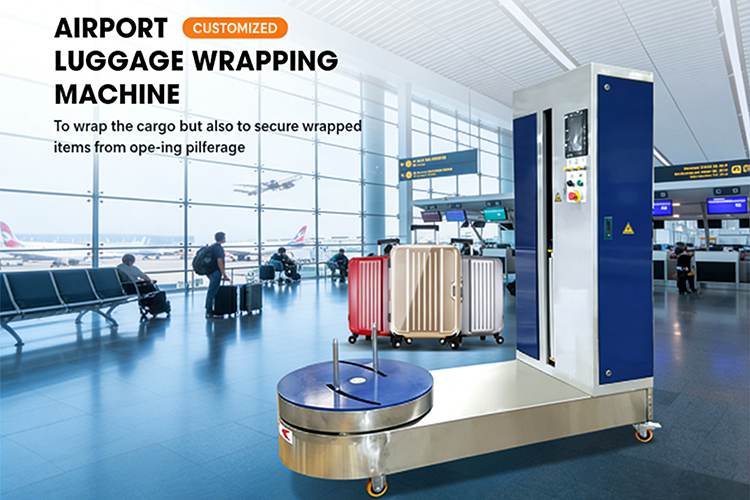
Luggage Wrapping Machine for Airports
view more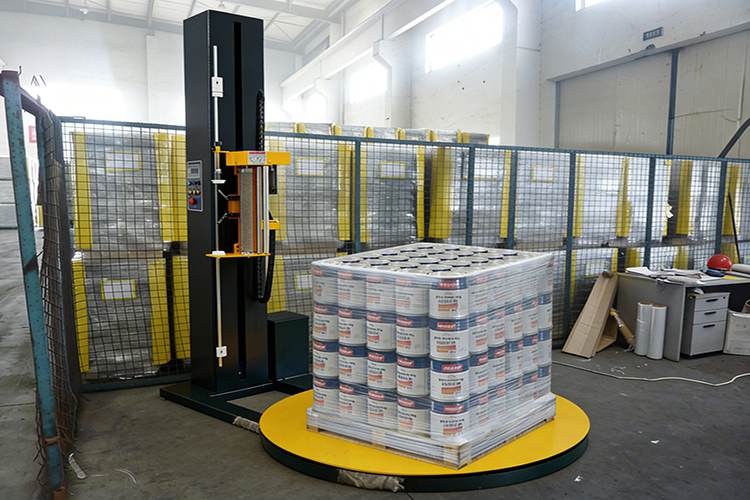
Pallet Stretch Wrapping Machine for Canned Goods
view more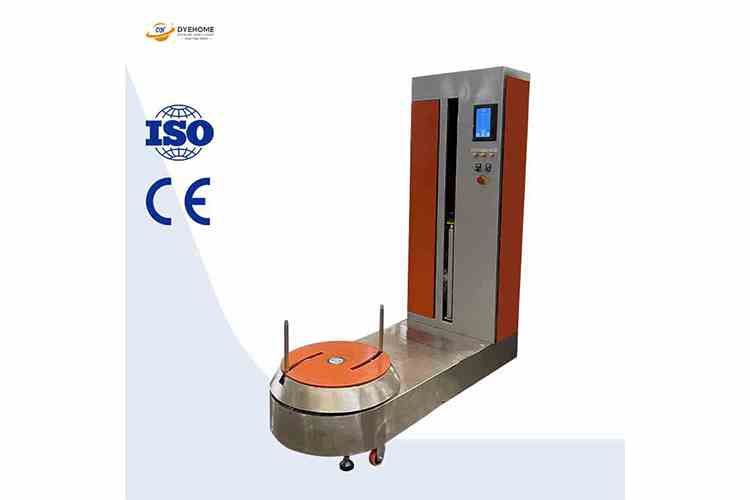
Airport Self-Service Luggage Wrapping Machine
view more
Cantilever wrapping film packaging machine
view more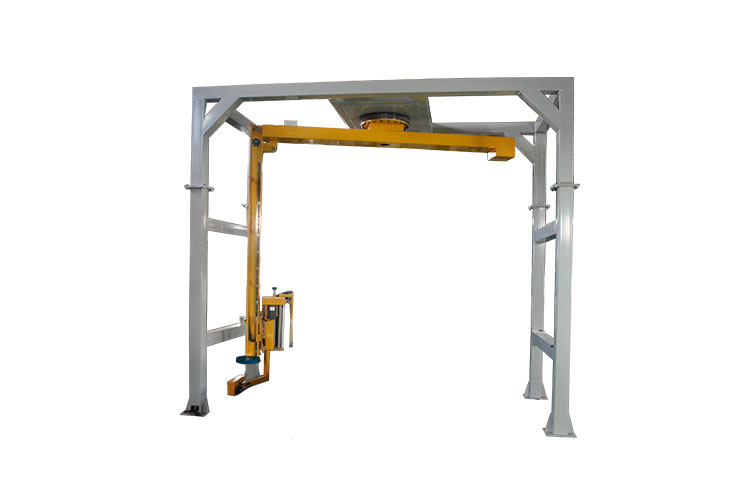
Gantry fully automatic cantilever wrapping machine
view more
 Shandong Dyehome Intelligent Equipment Co.,Ltd
Phone:0086-17362172587
Whatsapp:+8617362172587
Email:machinedyehome@gmail.com
Add:Building 62, 3000 Meili East Road, DmiPark, Wujiapu Street, Huaiyin District, Jinan City,Shandong Province
Jinan Jiasen Packaging Equipment Co., LtdPhone:0086-15665802370
Add:High-end Equipment Manufacturing Industrial Park, East Industrial New Town, Ancheng Town, Pingyin County, Jinan City, Shandong Province
Shandong Golden Pack Intelligent Equipment Co.,LtdPhone:0086-15662690213
Add:High-end Equipment Manufacturing Industrial Park, East Industrial New Town, Ancheng Town, Pingyin County, Jinan City, Shandong Province
YoursIndustry
OurSolutions
OurServices
OurInformation