

Pallet Wrapping Machine 2026:Top Types,Models&How to Pick the Right One
Quick Definition:A pallet wrapping machine(also called a pallet wrapper or stretch wrapper)is an industrial packaging device that applies stretch film around palletized loads to secure them for storage and transit.The"best"machine depends on your throughput volume,load characteristics,facility layout,and budget—there is no single universal answer.
If you are evaluating a new pallet wrapping machine in 2026,you are not alone.The global pallet stretch wrapping machine market reached USD 3.8 billion in 2025 and is projected to hit USD 4.03 billion in 2026,growing at a 6.1%CAGR through 2036(source:Grand View Research).From small manufacturing plants to large 3PL distribution centers,businesses across every industry are upgrading from manual wrapping to automated solutions—and the variety of options can be overwhelming.
This guide breaks down the best pallet wrapping machines available in 2026 by type,compares them across 7 key dimensions,and gives you a clear decision framework to select the right model for your specific operation.
1.The 6 Main Types of Pallet Wrapping Machines(And When to Use Each)
Understanding machine types is the first step to finding the best pallet wrapper for your needs.Each type solves a different set of operational challenges.
1.1 Semi-Automatic Turntable Stretch Wrapper
Best for:Small to mid-size operations wrapping 15–30 pallets per day
The turntable pallet wrapper is the most widely deployed configuration worldwide.The pallet sits on a motorized rotating turntable while the film carriage travels vertically along a fixed mast,wrapping the load with consistent tension.
Throughput:15–30 pallets/hour
Max load weight:Typically 1,500–2,000 kg
Price range:$3,000–$10,000
Key advantage:Lowest entry cost,simplest operation,minimal training required
Limitation:Not suitable for very heavy,tall,or unstable loads that cannot safely rotate
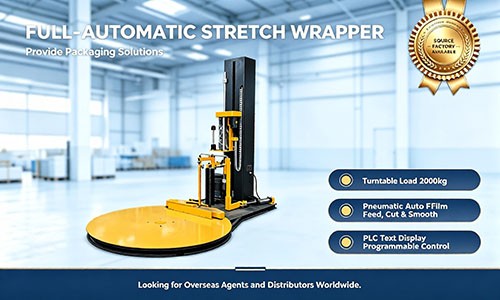
1.2 Automatic Turntable Stretch Wrapper
Best for:Medium to high-volume operations wrapping 30–60 pallets per day
The automatic version adds conveyor integration,automatic film cutting,and programmable wrap patterns.Operators load the pallet via conveyor,and the machine completes the full wrapping cycle without manual intervention.
Throughput:30–50 pallets/hour
Max load weight:Up to 2,500 kg
Price range:$10,000–$25,000
Key advantage:Hands-free operation,consistent wrap quality,conveyor-line compatible
Limitation:Higher upfront investment;requires dedicated floor space
1.3 Rotary Arm(Cantilever)Stretch Wrapper
Best for:Heavy,unstable,or top-heavy loads that cannot rotate
Instead of spinning the pallet,a powered wrapping arm orbits around the stationary load.This eliminates centrifugal forces that could destabilize fragile or unevenly distributed pallets.
Throughput:30–60 pallets/hour
Max load weight:No practical upper limit(pallet stays stationary)
Price range:$15,000–$50,000+
Key advantage:Handles unstable,extra-heavy,or oversized loads safely;inline conveyor integration
Limitation:Higher cost;larger floor footprint
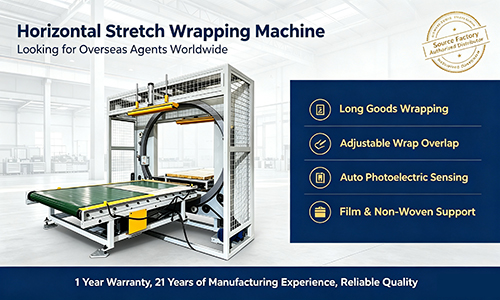
1.4 Horizontal(Orbital)Stretch Wrapper
Best for:Long,irregular,or non-palletized products(pipes,lumber,doors,profiles)
The load moves through a rotating ring that applies film in a horizontal spiral pattern.This is fundamentally different from vertical wrap—it is designed for products that are too long,wide,or oddly shaped for standard pallet wrappers.
Throughput:Variable depending on product length and line speed
Price range:$8,000–$35,000
Key advantage:Wraps long and irregular products that vertical wrappers cannot handle
Limitation:Specialized application;not a replacement for standard pallet wrapping
1.5 Robotic(Mobile)Stretch Wrapper
Best for:Large warehouses with multiple wrapping locations or space constraints
A self-propelled robot navigates autonomously to each pallet and wraps it in place.No fixed installation,floor anchoring,or conveyor is needed.
Throughput:20–40 pallets/hour
Price range:$25,000–$60,000+
Key advantage:Maximum flexibility,no fixed installation,relocatable between zones
Limitation:Highest unit cost;requires flat,clean floor surfaces for autonomous navigation
1.6 Stretch Hood Machine
Best for:High-speed,premium-load protection(food,chemicals,building materials)
A stretch hood pulls a tubular film sleeve over the entire pallet load from top to bottom,providing a weatherproof,fully enclosed wrap.This is the premium tier of pallet packaging.
Throughput:60–120 pallets/hour
Price range:$50,000–$150,000+
Key advantage:Full load enclosure,superior weather and dust protection,highest throughput
Limitation:Highest investment;film cost per pallet is higher than standard stretch wrap
2.How the Best Pallet Wrapping Machines Compare:7-Key-Dimension Matrix
The following comparison matrix helps you evaluate which type best fits your operation across the factors that matter most.
|
Dimension |
Semi-Auto Turntable |
Auto Turntable |
Rotary Arm |
Horizontal |
Robotic Mobile |
Stretch Hood |
|
Throughput(pallets/hr) |
15–30 |
30–50 |
30–60 |
Variable |
20–40 |
60–120 |
|
Max Load Weight |
2,000 kg |
2,500 kg |
Unlimited |
Varies |
Unlimited |
2,000 kg |
|
Load Stability Required |
Stable loads only |
Stable loads |
Unstable OK |
Irregular shapes |
Unstable OK |
Stable loads |
|
Conveyor Integration |
No |
Yes |
Yes |
Yes |
No |
Yes |
|
Floor Space |
Small |
Medium |
Large |
Long footprint |
Minimal |
Medium |
|
Best Application |
Small factory |
Mid-volume plant |
Heavy/unsafe loads |
Long products |
Multi-zone warehouse |
High-speed premium |
3.Top 5 Factors to Determine the Best Pallet Wrapper for YOUR Operation
Rather than searching for a generic"best"machine,use this decision framework to identify the best pallet wrapping machine for your specific situation.
Factor 1:Daily Throughput Volume
Your daily pallet count is the single most important filter:
Under 15 pallets/day→Semi-automatic turntable is sufficient and most cost-effective
15–50 pallets/day→Automatic turntable or rotary arm,depending on load type
50–100+pallets/day→Rotary arm,stretch hood,or multiple stations
Variable/seasonal volume→Robotic mobile wrapper offers scalability without overcommitting
Factor 2:Load Weight and Stability
Evaluate your typical pallet loads:
Stable,uniform loads under 2,000 kg→Turntable machines work perfectly
Heavy loads over 2,000 kg→Rotary arm(pallet stays stationary)
Unstable,top-heavy,or irregular loads→Rotary arm or robotic mobile
Long products(pipes,lumber,profiles)→Horizontal wrapper is the only viable option
Factor 3:Facility Layout and Space
Limited floor space→Robotic mobile or compact semi-automatic turntable
Existing conveyor line→Automatic turntable or rotary arm with conveyor integration
Multiple wrapping locations→Robotic mobile wrapper eliminates the need for multiple fixed stations
Outdoor or temporary operations→Robotic mobile(no installation required)
Factor 4:Budget and Total Cost of Ownership
Look beyond the purchase price:
|
Cost Component |
Semi-Auto Turntable |
Automatic Turntable |
Rotary Arm |
Robotic Mobile |
|
Machine cost |
$3K–$10K |
$10K–$25K |
$15K–$50K |
$25K–$60K |
|
Installation |
Minimal |
Moderate |
Significant |
None |
|
Film savings |
Standard |
15–25%vs.manual |
20–30%vs.manual |
15–25%vs.manual |
|
Labor required |
1 operator |
0–1 operator |
0–1 operator |
0 operators |
|
Maintenance |
Low |
Moderate |
Moderate |
Moderate-High |
|
Payback period |
6–12 months |
12–18 months |
18–24 months |
24–36 months |
Key insight:An automatic turntable wrapper that saves$40,000–$60,000/year in labor and film costs(based on replacing 2 manual workers and reducing film waste by 20–30%)typically pays for itself within 12–18 months.
Factor 5:Industry-Specific Requirements
Certain industries have additional compliance and performance requirements:
Food&Beverage:Stainless steel components,washdown-rated machines,FDA-compliant film contact surfaces
Chemical:Anti-static features,explosion-proof motors for hazardous environments,corrosion-resistant construction
Building Materials:Heavy-duty turntables for high-weight loads(cement,tiles),horizontal wrappers for long products
3C Electronics:Anti-static protection,precision film tension control to avoid product damage
Automotive Parts:High containment force requirements for dense,heavy components
4.Industry Trends Shaping the Best Pallet Wrapping Machines in 2026
Several technology and market trends are reshaping what"best"means in 2026:
4.1 IoT and Smart Wrapping
Modern machines now feature IoT-enabled sensors that monitor film tension,consumption,and wrapping quality in real time.Predictive maintenance alerts reduce unplanned downtime,and data dashboards provide wrap quality analytics for continuous process improvement.
4.2 AMR Integration
Leading manufacturers like Lantech have launched semi-automatic wrappers with Autonomous Mobile Robot(AMR)integration—enabling seamless coordination between mobile robots and wrapping stations in smart warehouse environments.
4.3 Advanced Pre-Stretch Technology
Pre-stretch ratios of 250%–300%are now standard on mid-range and premium machines,reducing film consumption by 25–40%compared to basic systems.This translates directly to lower operating costs and reduced environmental impact.
4.4 Sustainability and Downgauging
The industry is shifting toward thinner,high-performance films and biodegradable options.The best machines in 2026 are optimized for downgauged films(as thin as 10–12 microns)without sacrificing load containment,helping companies meet sustainability targets while cutting material costs.
4.5 Market Growth
The global automatic stretch wrapper market alone is projected to grow from USD 2.52 billion(2025)to USD 3.83 billion by 2032 at a 6.12%CAGR,driven by e-commerce expansion,labor cost increases,and smart warehouse adoption(source:P Market Research).
5.Why Choose Dyehome Pallet Wrapping Machines?
Shandong Dyehome Intelligent Equipment Co.,Ltd.brings 21+years of manufacturing experience and holds 30+invention and utility model patents in stretch wrapping and end-of-line packaging technology.
The Dyehome product range covers the full spectrum of pallet wrapping needs:
Turntable stretch wrappers(semi-automatic and automatic)—for standard warehouse and manufacturing applications
Rotary arm(cantilever)stretch wrappers—for heavy,unstable,or oversized loads
Horizontal stretch wrappers—for long products such as pipes,profiles,and lumber
Luggage wrapping machines—for airport and travel retail applications
Inline automatic wrapping lines—for high-volume,fully automated end-of-line packaging
Complete end-of-line solutions—including case erectors,case sealers,conveyors,strapping machines,and palletizers
Every Dyehome machine is engineered with advanced pre-stretch technology,PLC-based programmable controls,and CE certification for global market compliance.The company serves customers across the chemical,building materials,3C electronics,automotive,paper,food&beverage,and logistics industries.
FAQ
Q: What is the best pallet wrapping machine for a small warehouse?
A: For small warehouses wrapping under 15 pallets per day with standard stable loads, a semi-automatic turntable stretch wrapper is the best choice. It offers the lowest entry cost ($3,000–$10,000), minimal training requirements, and reliable performance. If your loads are heavy or unstable, consider a rotary arm model instead.
Q: How much does a good pallet wrapping machine cost in 2026?
A: Prices range from $3,000 for a basic semi-automatic turntable to $150,000+ for a high-speed stretch hood system. For most mid-size operations, an automatic turntable wrapper in the $10,000–$25,000 range provides the best balance of performance, automation, and ROI, typically paying for itself within 12–18 months.
Q: Which type of pallet wrapper is fastest?
A: Stretch hood machines are the fastest, handling 60–120 pallets per hour. For standard stretch wrapping, high-speed rotary arm machines reach 30–60 pallets per hour and offer the best speed-to-flexibility ratio for most high-volume operations.
Q: Can a pallet wrapping machine handle unstable or top-heavy loads?
A: Yes, but not all types. Rotary arm wrappers and robotic mobile wrappers keep the pallet stationary during wrapping, making them ideal for unstable, top-heavy, or irregular loads. Standard turntable wrappers rotate the pallet, which can be unsafe for unstable loads.
products
Horizontal Stretch Wrapping Machine SP1000 for Pipes
view more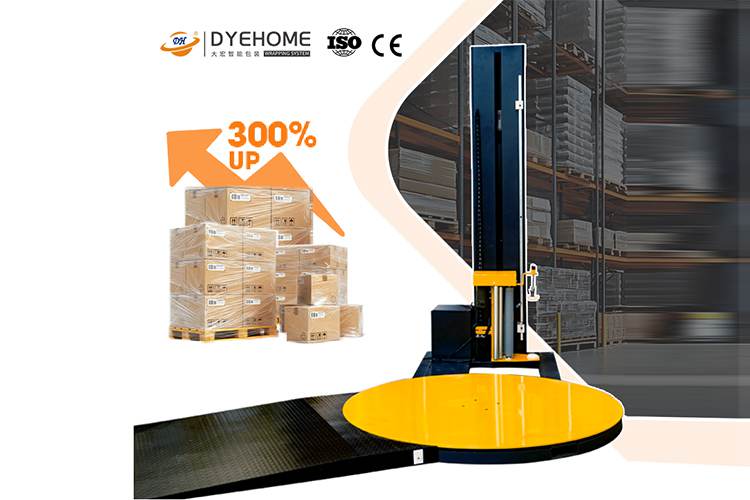
Pallet Stretch Wrapping Machine
view more
Top Press Pallet Stretch Wrapping Machine
view more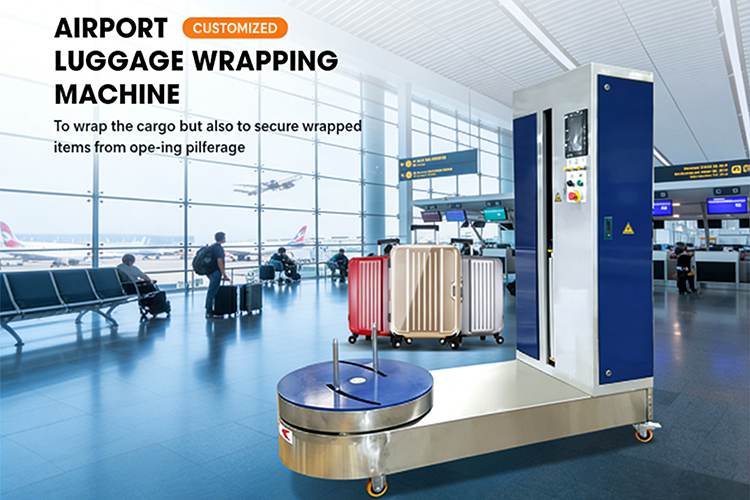
Luggage Wrapping Machine for Airports
view more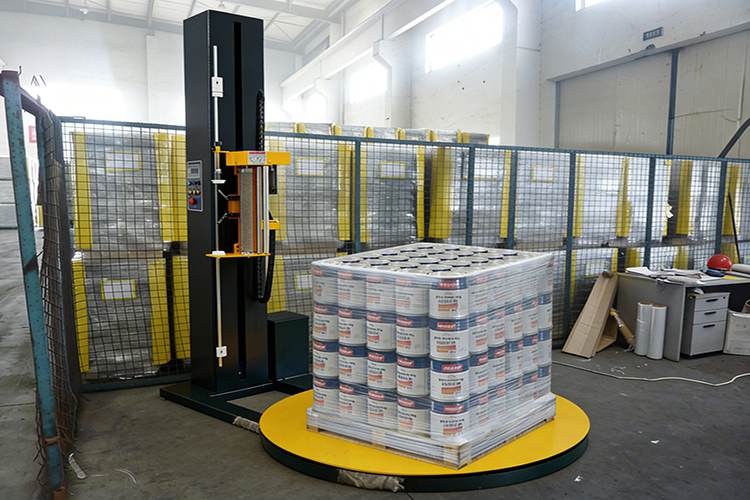
Pallet Stretch Wrapping Machine for Canned Goods
view more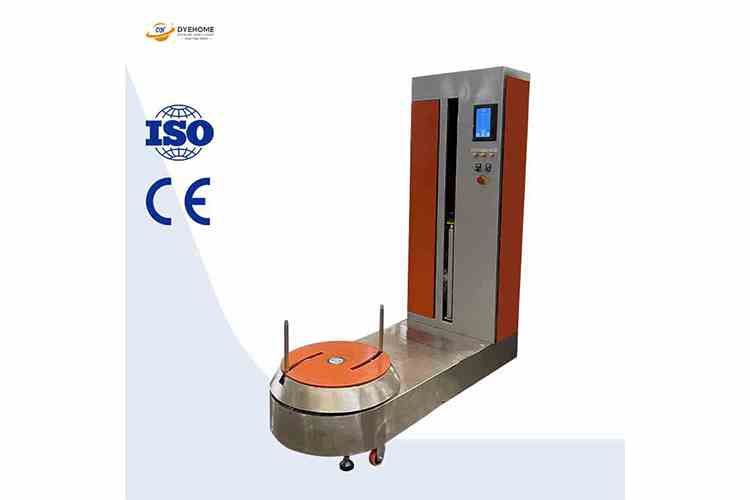
Airport Self-Service Luggage Wrapping Machine
view more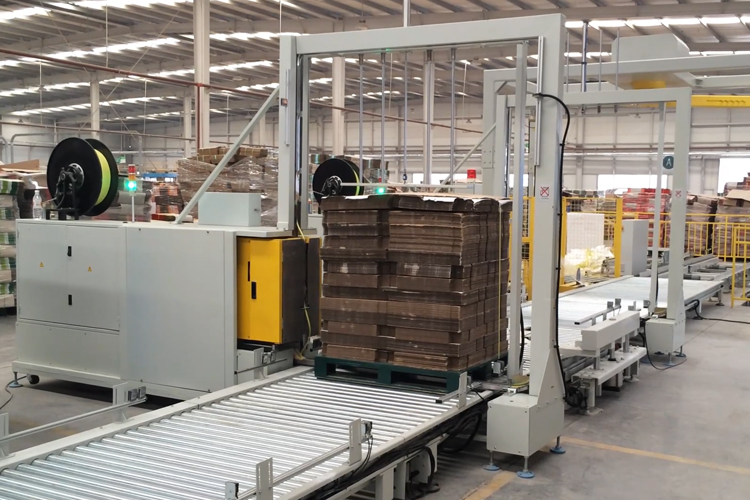
Automated film wrapping and packaging equipment
view more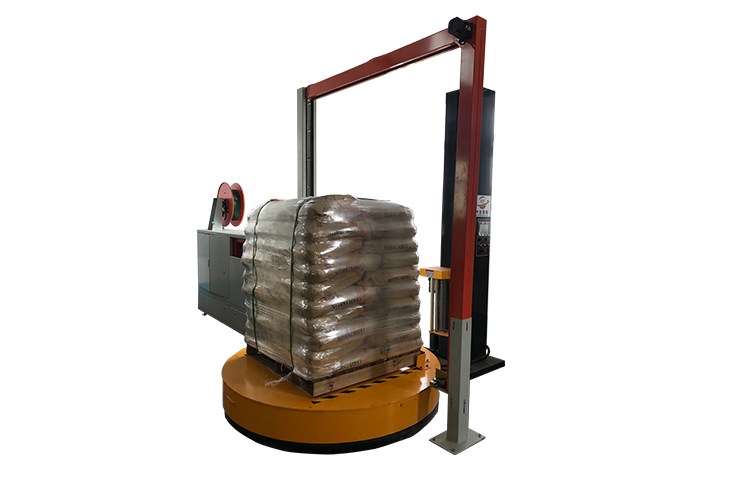
Sword-piercing baler and wrapping machine
view more
 Shandong Dyehome Intelligent Equipment Co.,Ltd
Phone:0086-17362172587
Whatsapp:+8617362172587
Email:machinedyehome@gmail.com
Add:Building 62, 3000 Meili East Road, DmiPark, Wujiapu Street, Huaiyin District, Jinan City,Shandong Province
Jinan Jiasen Packaging Equipment Co., LtdPhone:0086-15665802370
Add:High-end Equipment Manufacturing Industrial Park, East Industrial New Town, Ancheng Town, Pingyin County, Jinan City, Shandong Province
Shandong Golden Pack Intelligent Equipment Co.,LtdPhone:0086-15662690213
Add:High-end Equipment Manufacturing Industrial Park, East Industrial New Town, Ancheng Town, Pingyin County, Jinan City, Shandong Province
YoursIndustry
OurSolutions
OurServices
OurInformation