

Which Pallet Wrapper Is Right for Me?A 6-Step Decision Framework(2026)
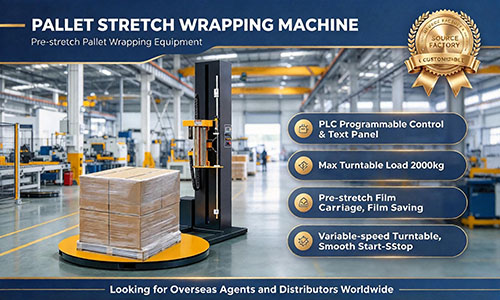
Choosing the right pallet wrapper starts with answering six questions about your operation—not with browsing machine catalogs.The correct stretch wrapping machine for your facility depends on your daily pallet volume,load characteristics(weight,height,stability),available floor space,integration requirements,and budget constraints.With the global pallet wrapping machine market projected to reach**$8.41 billion by 2032**(Reanin,2026)and dozens of machine types available,making the wrong choice can cost$10,000–$50,000+in wasted capital and ongoing operational inefficiency.
This guide eliminates the guesswork.Follow our 6-step decision framework to identify exactly which pallet wrapper matches your specific operation—whether you run a small warehouse wrapping 15 pallets per day or a high-volume distribution center processing 200+pallets daily.
Step 1:Calculate Your Daily Pallet Volume
Your daily throughput requirement is the single most important factor in pallet wrapper selection.It determines whether you need a manual,semi-automatic,or fully automatic system—and directly impacts your ROI timeline.
Volume-Based Machine Matching
Step 2:Assess Your Load Characteristics
Not all pallets are created equal.The physical properties of your loads determine which machine architecture—turntable,rotary arm,or horizontal—will deliver consistent,damage-free wrapping.
The Load Profile Checklist
Evaluate each of your typical loads against these five criteria:
Weight:Is the loaded pallet under 1,500 kg,between 1,500–2,500 kg,or over 2,500 kg?
Height:Does the load extend below 1,800 mm,between 1,800–2,200 mm,or above 2,200 mm?
Stability:Is the load uniformly stacked and self-supporting,or does it contain loose,irregular,or overhanging items?
Center of gravity:Is the weight evenly distributed,or is the load top-heavy?
Special characteristics:Does the load contain liquids(sloshing risk),fragile items(crush risk),or oversized dimensions?
Load Profile→Machine Type Mapping
|
Load Characteristic |
Best Machine Type |
Why |
|
Stable,uniform boxes/cases,under 2,000 kg |
Turntable stretch wrapper |
Centrifugal force helps cinch film tightly;most cost-effective |
|
Tall,top-heavy,or unstable loads |
Rotary arm(cantilever)wrapper |
Load stays stationary—zero risk of toppling during wrapping |
|
Liquid-filled containers(drums,IBC totes) |
Rotary arm wrapper |
No rotation=no sloshing;pallet remains on the floor |
|
Long,irregular,or oversized loads |
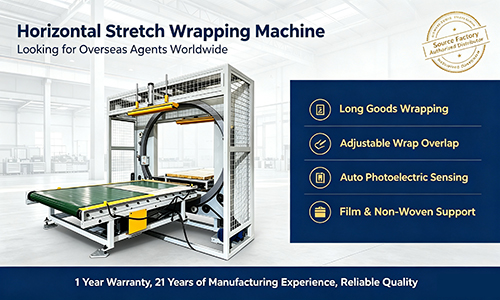
Horizontal(orbital)wrapper |
Wraps horizontally—handles any length without height restrictions |
|
Mixed load profiles(varying daily) |
Rotary arm with adjustable settings |
Handles light to heavy,stable to unstable—maximum versatility |
Critical warning:Using a turntable wrapper for unstable or liquid-filled loads is the most common purchasing mistake.The centrifugal force generated during rotation can cause product displacement,liquid sloshing,or complete load collapse—resulting in damaged goods,film waste,and potential safety hazards.
Step 3:Evaluate Your Facility Constraints
Even the perfect machine will underperform if it does not fit your facility.Before selecting a pallet wrapper,measure and document these three spatial requirements.
Floor Space Requirements
|
Machine Type |
Minimum Floor Footprint |
Additional Clearance Needed |
|
Turntable(1650 mm diameter) |
~3.0 m×3.0 m |
Radial clearance for pallet overhang(typically 300–500 mm beyond turntable edge) |
|
Rotary arm(2000 mm arm) |
~4.5 m×4.5 m |
Overhead clearance for arm rotation;no radial floor clearance needed |
|
Horizontal wrapper |
Varies by model(typically 6–12 m linear) |
Linear conveyor length;entry/exit clearance |
|
Inline automatic system |
10–20 m linear conveyor line |
Full integration space including accumulation tables,conveyors,and exit zones |
Other Facility Factors
Floor condition:Turntables require level,solid flooring capable of supporting combined turntable+loaded pallet weight(up to 3,000+kg dynamic load)
Ceiling height:Rotary arm and horizontal wrappers require adequate overhead clearance(typically 3.0–3.5 m minimum)
Power supply:Verify voltage(220V/380V/480V)and phase(single/three-phase)availability at the installation point
Environmental conditions:Food and pharmaceutical applications may require stainless steel construction or IP-rated components for washdown environments
Forklift access:Ensure forklift operators can efficiently load/unload the wrapper without congestion—a commonly overlooked factor that directly impacts throughput
Step 4:Determine Your Integration Requirements
The question is not just what to wrap,but how the wrapper fits into your workflow.
Standalone vs.Inline:Which Fits Your Operation?
Choose standalone(semi-auto or auto)if:
Pallets are brought to the wrapper by forklift or pallet jack
You have a dedicated wrapping area near the shipping dock
Your operation runs 1–3 shifts with flexible pallet routing
You want to minimize installation complexity and cost
Choose inline(conveyor-integrated)if:
Pallets move automatically from production or palletizing to wrapping
You need consistent,hands-free operation at fixed cycle times
Daily volume exceeds 100 pallets
You are building or upgrading a complete end-of-line packaging system
Hybrid approach:Many mid-size operations start with a standalone semi-automatic wrapper and add conveyor integration later as volume grows.When selecting your initial machine,confirm that the model supports future automation upgrades(e.g.,auto film cut,programmable wrap patterns,conveyor interface modules).
Automation Features Worth Investing In
Regardless of standalone or inline configuration,these features significantly impact operational efficiency:
Powered pre-stretch carriage(200–300%stretch ratio):Reduces film consumption by 30–50%vs.non-pre-stretch models
Automatic film cutting and clamping:Eliminates manual film handling,saves 5–8 seconds per cycle
PLC with recipe storage:Store wrap programs for different SKUs—critical for operations handling 10+product types
Automatic height detection:Photoelectric sensor detects load height and adjusts wrap pattern—prevents film waste on shorter loads
Variable speed turntable/arm:Allows optimization for fragile vs.stable loads
Step 5:Set Your Realistic Budget(Including Total Cost of Ownership)
The purchase price is only 30–40%of your pallet wrapper's total cost of ownership over a 10-year lifespan.A comprehensive budget must account for all cost components.
Total Cost of Ownership Breakdown
|
Cost Component |
%of 10-Year TCO |
Typical Range(USD) |
|
Machine purchase price |
30–40% |
$3,000–$150,000 |
|
Installation&commissioning |
3–5% |
$500–$10,000 |
|
Stretch film consumption |
25–35% |
$15,000–$80,000+ |
|
Maintenance&spare parts |
8–12% |
$3,000–$20,000 |
|
Operator labor |
10–20% |
$8,000–$50,000+ |
|
Energy consumption |
2–3% |
$1,500–$5,000 |
The film cost factor:Stretch film is typically the largest ongoing cost after the initial machine investment.A machine with a high-performance powered pre-stretch system(250–300%stretch ratio)can save$2,000–$5,000 per year in film costs alone vs.a basic model—often justifying a higher purchase price within 2–3 years.
Budget-Based Recommendations
|
Budget Range |
Best Options |
Ideal For |
|
Under$5,000 |
Semi-auto turntable(basic model) |
Small warehouses,10–25 pallets/day |
|
$5,000–$15,000 |
Semi-auto turntable/rotary arm(with pre-stretch) |
Mid-size operations,25–60 pallets/day |
|
$15,000–$50,000 |
Fully automatic turntable or rotary arm |
High-volume operations,60–150 pallets/day |
|
$50,000+ |
Inline automatic system with conveyor |
Large distribution centers,150+pallets/day |
Step 6:Match Your Answers to the Right Machine
Now combine your answers from Steps 1–5 using this decision matrix.
The Complete Decision Matrix
|
Your Profile |
Recommended Machine |
Key Reason |
|
15–40 pallets/day,stable loads,limited space,budget<$10K |
Semi-auto turntable |
Best value for standard operations;compact footprint |
|
40–80 pallets/day,stable loads,moderate space,budget$10K–$30K |
Fully automatic turntable |
Higher throughput with minimal operator involvement |
|
Any volume,tall/unstable/liquid loads,moderate space,budget$8K–$45K |
Rotary arm(cantilever)wrapper |
Zero load rotation eliminates stability risks |
|
100+pallets/day,standard loads,large facility,budget$50K+ |
Inline automatic conveyor system |
Maximum throughput;fully hands-free operation |
|
Long/irregular loads(pipes,lumber,carpet rolls),any volume |
Horizontal(orbital)wrapper |
Only machine type that handles length without height limits |
|
15–30 pallets/day,mixed loads,limited budget |
Semi-auto rotary arm |
Maximum versatility at entry-level price point |
Quick-Reference Flowchart
For a simplified decision path:
Are your loads unstable,tall(>2,000 mm),or liquid-filled?
Yes→Rotary arm wrapper
No→Go to step 2
Do you wrap 100+pallets per day?
Yes→Inline automatic conveyor system
No→Go to step 3
Are your loads long,irregular,or oversized(exceeding standard pallet dimensions)?
Yes→Horizontal(orbital)wrapper
No→Go to step 4
Do you wrap 40+pallets per day with stable,uniform loads?
Yes→Fully automatic turntable
No→Semi-automatic turntable
Common Mistakes to Avoid When Choosing a Pallet Wrapper
Based on industry data and field experience,these are the five most costly purchasing errors:
Buying based on price alone:A$3,000 machine without powered pre-stretch will cost$2,000–$5,000 more per year in film waste vs.a$6,000 model with 250%pre-stretch—erasing the upfront"savings"within 1–2 years
Ignoring load stability:Choosing a turntable for fragile or top-heavy loads leads to product damage,film waste,and operator frustration—the#1 reason machines sit unused after purchase
Undersizing for future growth:Buying a machine rated for your current volume with zero headroom.When production increases 20–30%(which it typically does within 2 years),you outgrow the machine and face a second capital expenditure
Overlooking facility requirements:Failing to measure floor space,ceiling height,power supply,and forklift access before ordering—resulting in expensive facility modifications or a machine that simply does not fit
Skipping the sample wrap test:Reputable manufacturers offer free sample wrapping using your actual pallets and film.Always request this test—it reveals compatibility issues before you commit to a purchase
FAQ: Which Pallet Wrapper Is Right for Me
Q: What is the most common pallet wrapper for small warehouses?
A: A semi-automatic turntable stretch wrapper is the most common choice for small warehouses wrapping 10–40 pallets per day. It offers the best balance of performance, footprint, and price — with entry-level models starting around $3,000. Look for a model with a powered pre-stretch carriage to reduce film costs by 30–50%.
Q: Can one pallet wrapper handle different types of loads?
A: Yes, but versatility depends on the machine type. A rotary arm wrapper offers the broadest load compatibility — it handles stable boxes, fragile items, tall loads, and liquid-filled containers without modification. Turntable wrappers are more limited; they work best with stable, uniform loads and struggle with tall, fragile, or liquid products.
products
Horizontal Stretch Wrapping Machine SP1000 for Pipes
view more
Pallet Stretch Wrapping Machine
view more
Top Press Pallet Stretch Wrapping Machine
view more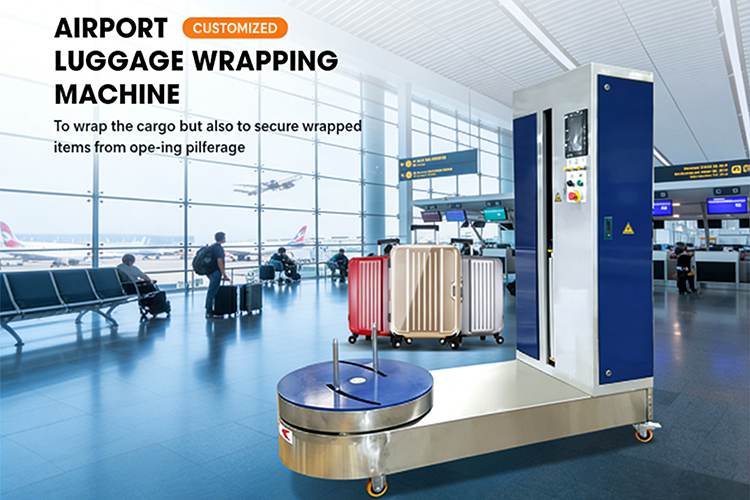
Luggage Wrapping Machine for Airports
view more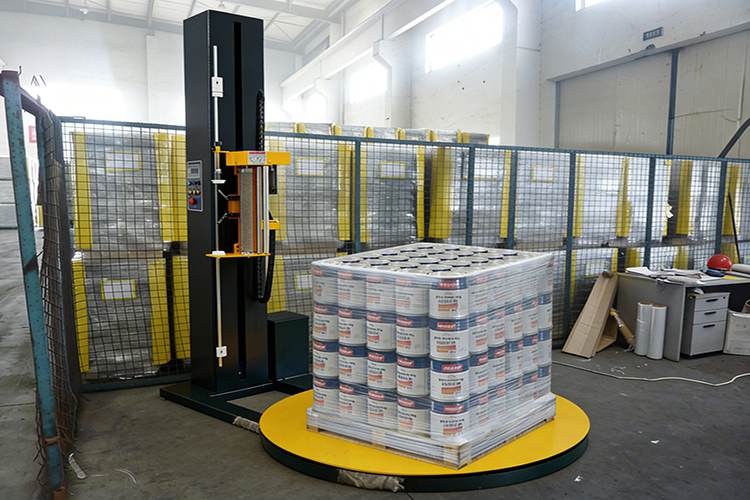
Pallet Stretch Wrapping Machine for Canned Goods
view more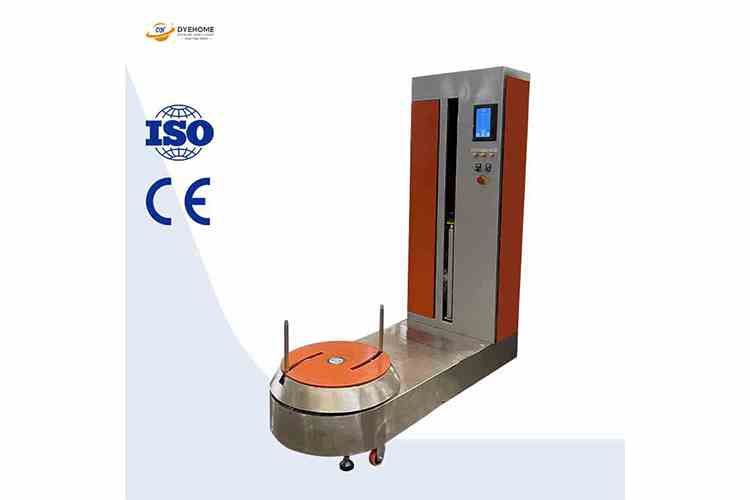
Airport Self-Service Luggage Wrapping Machine
view more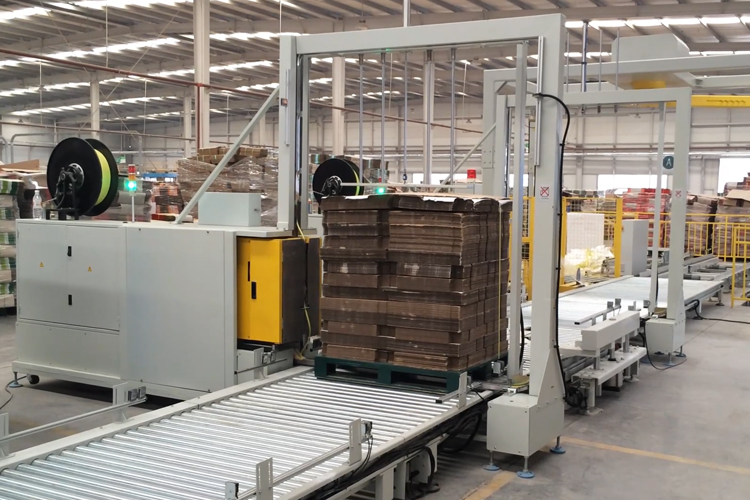
Automated film wrapping and packaging equipment
view more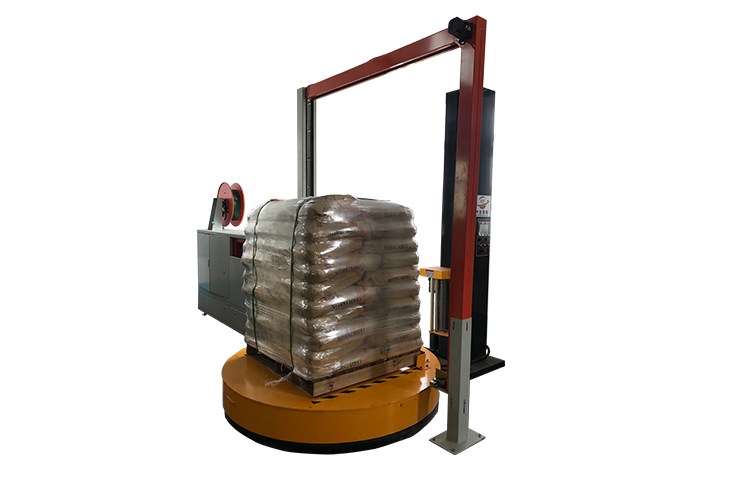
Sword-piercing baler and wrapping machine
view more
 Shandong Dyehome Intelligent Equipment Co.,Ltd
Phone:0086-17362172587
Whatsapp:+8617362172587
Email:machinedyehome@gmail.com
Add:Building 62, 3000 Meili East Road, DmiPark, Wujiapu Street, Huaiyin District, Jinan City,Shandong Province
Jinan Jiasen Packaging Equipment Co., LtdPhone:0086-15665802370
Add:High-end Equipment Manufacturing Industrial Park, East Industrial New Town, Ancheng Town, Pingyin County, Jinan City, Shandong Province
Shandong Golden Pack Intelligent Equipment Co.,LtdPhone:0086-15662690213
Add:High-end Equipment Manufacturing Industrial Park, East Industrial New Town, Ancheng Town, Pingyin County, Jinan City, Shandong Province
YoursIndustry
OurSolutions
OurServices
OurInformation