

Why Are Checked Bags on International Flights So Easily Damaged? More Airports Are Now Using Airport Luggage Wrapping Machines
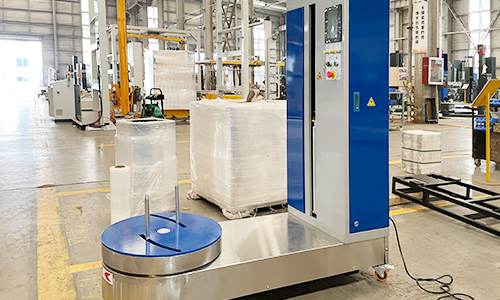
Why Most Luggage Damage Actually Happens During Transfer Handling
Many first-time travelers think checked baggage simply gets transported from one destination to another. But after experiencing international transfers, they realize that luggage problems usually happen not during the flight itself, but during handling and transit operations.
Especially on international flights or routes with multiple transfers, luggage often goes through repeated loading, unloading, conveyor transportation, and stacking. During continuous collisions and compression, many suitcases can suffer cracked corners, broken zippers, or damaged shells.
Soft-shell luggage and suitcases with external straps or accessories are even more vulnerable to tearing or snagging during transportation. Many travelers only discover after arriving that:
- The suitcase surface is heavily scratched
- Zippers have burst open
- External accessories are missing
- Corners are cracked or damaged
As a result, more airports are introducing airport luggage wrapping machines to fully wrap baggage with LLDPE stretch film and improve protection during transit.
Why International Transfer Luggage Is More Likely to Be Damaged
Many travelers notice that short domestic flights rarely cause serious issues, while international transfer routes significantly increase the risk of baggage damage.
This is mainly because international transfers involve:
- More handling operations
- Longer transportation time
- Tighter luggage stacking
- Higher loading and unloading frequency
During peak travel periods, large volumes of baggage are transported simultaneously, making collisions and compression much more common. Even hard-shell suitcases, although stronger in appearance, still have vulnerable corners and edges.
The biggest advantage of airport luggage wrapping machines is not simply “adding one layer of film.”
The real purpose is to create an overall protective layer around the luggage.
This helps reduce surface scratches while also lowering the risk of zippers opening and external items falling off during transportation.
Today, many frequent international travelers and business passengers have gradually developed a habit:
“Wrap the luggage before checking it in.”
Why Airports Are Paying More Attention to Luggage Wrapping Services
In the past, many airports did not place much importance on luggage wrapping services. But today, more airports are actively adding baggage wrapping stations.
The reasons are practical.
On one hand, passengers now expect better baggage safety. On the other hand, airports also hope to reduce complaints caused by damaged luggage.
Especially in international airports, railway stations, and major passenger terminals, passenger traffic is extremely high. If wrapping services are inefficient, long queues can quickly form.
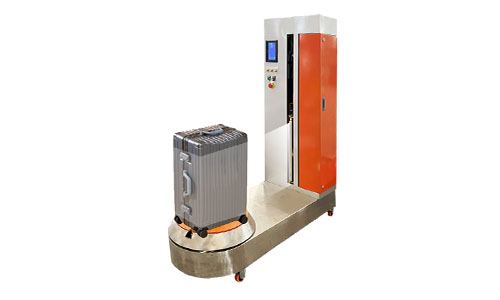
As a result, many airports are adopting compact luggage wrapping machines such as the LP600S, which use automatic turntable wrapping systems to improve packaging efficiency on-site.
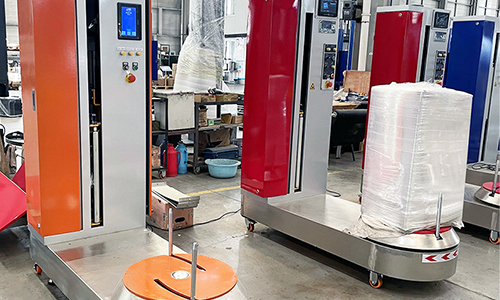
Compared with manual wrapping, compact automatic luggage wrapping equipment occupies less space while maintaining more stable wrapping speed, making it more suitable for continuous operation in public service areas.
Why More Travelers Are Concerned About Luggage Being Opened
Besides transportation damage, many travelers are now paying closer attention to luggage security.
During international travel, passengers often carry:
- Cosmetics
- Luxury goods
- Electronic products
- Important documents and certificates
If luggage is opened during transit, belongings may fall out or become lost.
Once wrapped, the luggage forms a sealed external protective structure. If someone attempts to tamper with or open it, passengers can usually notice immediately.
Therefore, luggage wrapping today is not only about scratch protection, but also about improving overall baggage security during transportation.
Why Compact Luggage Wrapping Machines Are Better Suited for Airports
Many modern airport luggage wrapping machines are now designed with greater emphasis on compact size and easy operation.
Machines like the LP600S feature a compact structure that can easily be installed near check-in counters or baggage drop-off areas. Staff simply place the luggage on the turntable, adjust the fixing position according to suitcase size, and the machine automatically completes the wrapping process.
For airports today, the real concern is not “how large the machine is,” but rather:
- Whether it can run continuously during peak hours
- Whether waiting times remain short
- Whether wrapping speed stays stable
- Whether maintenance is convenient
As a result, compact and continuous-operation luggage wrapping equipment is becoming an increasingly popular choice for airports and public transportation facilities.
-
 Shandong Dyehome Intelligent Equipment Co.,Ltd
Phone:0086-17362172587
Whatsapp:+8617362172587
Email:machinedyehome@gmail.com
Add:Building 62, 3000 Meili East Road, DmiPark, Wujiapu Street, Huaiyin District, Jinan City,Shandong Province
Jinan Jiasen Packaging Equipment Co., LtdPhone:0086-15665802370
Add:High-end Equipment Manufacturing Industrial Park, East Industrial New Town, Ancheng Town, Pingyin County, Jinan City, Shandong Province
Shandong Golden Pack Intelligent Equipment Co.,LtdPhone:0086-15662690213
Add:High-end Equipment Manufacturing Industrial Park, East Industrial New Town, Ancheng Town, Pingyin County, Jinan City, Shandong Province
-
YoursIndustry
-
OurSolutions
-
OurServices
-
OurInformation