

pallet wrapping machine vs rotary arm wrapper vs Online Stretch Wrapper: Which Machine Should You Buy in 2026?
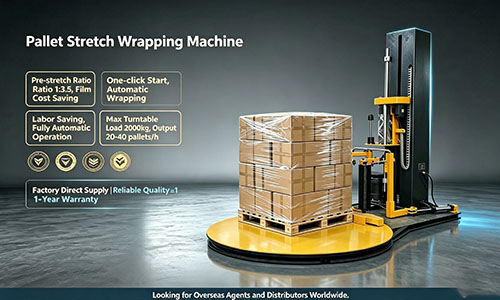
Every packaging operation that palletizes products eventually faces the same equipment question:which stretch wrapping configuration delivers the best combination of throughput,load security,and return on investment?
The answer is never universal.A food distributor running 40 identical pallets per day has entirely different requirements than a chemical plant wrapping heavy drums and IBC totes.A high-volume fertilizer facility shipping 200+pallets daily needs a different solution again.
This article compares the three most widely deployed stretch wrapping architectures—pallet,cantilever(rotary arm),and inline(automatic conveyor-integrated)systems—across the dimensions that actually matter for procurement decisions:throughput capacity,load compatibility,spatial requirements,automation level,and investment range.
pallet Stretch Wrappers
The industry workhorse—best for standard,stable pallets at moderate volume
|
Parameter |
Operating Range |
|
Throughput |
20–40 pallets per hour |
|
Max load weight |
2,000kg |
|
Max load height |
Up to 2,200 mm |
|
Film pre-stretch |
150%–350% |
|
Price range |
$3,000(semi-auto)to$50,000(fully automatic) |
|
Floor footprint |
Compact—requires radial clearance for rotation |
How it works
The loaded pallet sits on a motor-driven rotating platform.As the pallet spins,a film carriage mounted on a vertical mast travels up and down,wrapping stretch film around the load in a spiral pattern.The entire load rotates with the pallet.
When to choose a pallet
Your pallets are stable and uniform.Boxes,cases,bags,and tightly stacked products that won't shift during rotation.
Daily volume is under 80 pallets.pallet systems handle moderate throughput efficiently without the premium cost of inline systems.
Floor space is limited.Compact footprint—only need clearance around the pallet diameter.
Budget is a primary constraint.Semi-automatic models start around$3,000—the most affordable powered wrapping solution.
When NOT to choose a pallet
Loads are tall,top-heavy,or unstable.Centrifugal force can cause product displacement during rotation.
Pallets exceed 2,000kg.pallet bearing has a practical weight limit.
Products are liquid-filled.IBC totes and drums with fluids are poor candidates—rotation causes sloshing.
Page
Packaging Equipment·Buyer's Decision Guide·2026
Rotary Arm Stretch Wrappers
The heavy-load specialist—best for unstable,tall,or liquid-containing pallets
|
Parameter |
Operating Range |
|
Throughput |
40–60 pallets per hour |
|
Max load weight |
No practical limit(pallet stays stationary) |
|
Max load height |
Up to 2,400 mm |
|
Film pre-stretch |
150%–350% |
|
Price range |
$8,000 to$45,000 |
|
Floor footprint |
Larger—requires overhead clearance for arm sweep radius |
How it works
The pallet sits completely stationary on the floor.A powered arm extends horizontally from a vertical mast and rotates around the load,dispensing film as it orbits.The carriage also travels vertically,creating a spiral wrap pattern—but the load never moves.
When to choose a cantilever
Loads are heavy(1,000 kg+),tall,or top-heavy.Zero risk of product shifting,sloshing,or toppling during wrapping.
You wrap IBC totes,drums with liquids,or bulk bags.Liquid-filled containers and unstable FIBC bags benefit from zero-load-rotation wrapping.
Throughput is moderate to high(40–60 pallets/hour).Faster than pallets at the upper end with consistent operation.
Load weight varies dramatically between SKUs.Arm speed and film tension remain consistent regardless of pallet weight.
When NOT to choose a cantilever
Overhead clearance is restricted.The rotating arm requires vertical and horizontal space above the load.
Budget is extremely tight.Typically costs 2–3×more than comparable pallet models.
Wrapping only lightweight,stable pallets.If all loads are standard cartons under 500 kg,a pallet delivers the same result at lower cost.
Page
Packaging Equipment·Buyer's Decision Guide·2026
Online Stretch Wrapping machine
The high-volume solution—best for 100+pallets/day with minimal operator intervention
|
Parameter |
Operating Range |
|
Throughput |
10–30+pallets per hour(system-dependent) |
|
Max load weight |
Typically 2,000 kg(varies by sub-configuration) |
|
Max load height |
Up to 2,200 mm(with automatic height sensing) |
|
Film pre-stretch |
150%–350% |
|
Price range |
$50,000 to$150,000+(including conveyor integration) |
|
Floor footprint |
Largest—requires conveyor line length and integration space |
How it works
Online systems integrate directly into a conveyor line.Pallets are automatically conveyed into the wrapping station,wrapped without manual intervention,and discharged to the next station.The defining characteristic is full conveyor integration with automatic pallet detection,height sensing,and wrap cycle initiation.
When to choose an inline system
Daily volume exceeds 100 pallets consistently.Labor savings from eliminating manual wrapping justify the higher capital investment.
Multi-shift production(2–3 shifts/day).Consistent wrap quality around the clock without operator fatigue.
Regulatory compliance requires documented wrap consistency.Data logging,wrap pattern verification,and audit trails.
End-of-line integration needed.Seamless connection with upstream palletizers and downstream strappers or hooders.
When NOT to choose an inline system
Daily volume is under 50 pallets.Investment cannot be justified at lower throughput levels.
Capital budget is limited.Inline systems represent the highest investment tier($50,000+).
Facility layout cannot accommodate conveyor runs.Requires straight conveyor runs,transfer stations,and pallet accumulation space.
Page
Packaging Equipment·Buyer's Decision Guide·2026
Head-to-Head Comparison
|
Decision Factor |
pallet |
Cantilever |
Inline |
|
Load stability |
Stable,uniform loads only |
Handles unstable,tall,heavy,liquid |
Depends on sub-configuration |
|
Load rotates? |
Yes—spins with pallet |
No—stationary pallet |
Typically no |
|
Operator involvement |
Semi-auto(manual placement) |
Semi to fully auto |
Fully automatic |
|
Investment range |
$3,000–$50,000 |
$8,000–$45,000 |
$50,000–$150,000+ |
|
Floor space |
Smallest footprint |
Moderate(arm sweep) |
Largest(conveyor line) |
|
Payback timeline |
6–18 months |
12–24 months |
18–36 months |
|
Typical industries |
Food,general mfg,distribution |
Chemical,building materials,heavy industry |
High-volume food,fertilizer,consumer goods |
Decision Framework:Which Machine Should You Buy?
Step 1:What is your daily pallet volume?
Under 30 pallets/day→pallet(semi-automatic).Lowest investment,handles your volume comfortably.
30–100 pallets/day→Fully automatic pallet or cantilever.Proceed to Step 2.
Over 100 pallets/day→Serious candidate for an inline system.
Step 2:What does your load look like?
Stable cartons,cases,bags→pallet works well.
IBC totes,drums(especially liquid-filled),FIBC bags→Cantilever is the correct choice.Zero load rotation eliminates failure modes.
Mixed SKUs(stable+unstable)→Cantilever offers the widest compatibility window.
Step 3:What is your labor situation?
Operators available,manageable labor cost→Semi-automatic pallet or cantilever.
Labor scarce/expensive,multiple shifts→Inline system eliminates 2–3 manual wrapping positions.
Step 4:What is your budget?
Under$15,000→Semi-automatic pallet.
$15,000–$45,000→Fully automatic pallet or cantilever.
$50,000+→Inline system becomes viable if volume justifies it.
Quick decision:Standard stable loads+moderate volume+tight budget=pallet|Heavy/unstable/liquid loads+moderate-to-high volume=Cantilever|100+pallets/day+labor constraints+integration needs=Online
FAQ
Q1: Can a turntable wrapper handle IBC totes or liquid-filled drums?
Technically, pallet can wrap IBC totes — but it's not ideal. Rotation causes liquid to slosh inside the container, destabilizing the load. For IBC totes and liquid-filled drums, a rotary arm system is strongly recommended because the pallet remains stationary.
Q2: Is it worth upgrading from a turntable to a cantilever?
If you're experiencing load damage, wrap failures, or safety incidents caused by load instability during rotation — yes, the upgrade pays for itself quickly. If your current turntable handles all loads without issues, the cantilever's advantages are less impactful.
Q3: How long does it take to recoup the investment?
Typical payback ranges from 6 months (semi-automatic turntable replacing hand wrapping) to 12 months (online system). Primary savings: 30–50% less film vs. manual, lower labor costs, and decreased load damage claims during transit.
Q4: Can an inline system work with my existing palletizer?
Most inline stretch wrappers integrate with upstream palletizers from major manufacturers. Key requirements: compatible conveyor height, pallet detection sensor positioning, and PLC communication protocol.
Q5: What film savings can I expect from powered pre-stretch?
Machines with 300%+ powered pre-stretch reduce film consumption by 35–50% vs. hand wrapping. For a facility wrapping 100 pallets/day, this translates to $15,000–$40,000 in annual film savings.
products
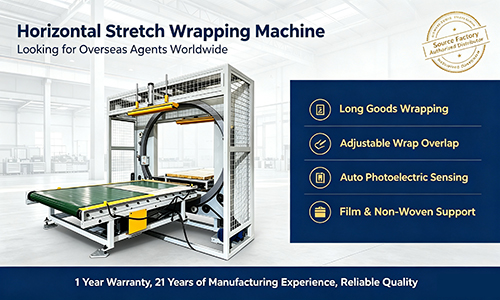
Horizontal Stretch Wrapping Machine SP1000 for Pipes
view more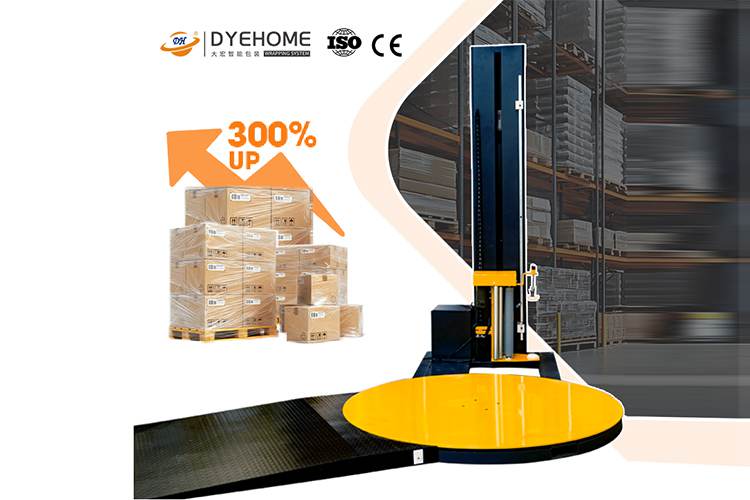
Pallet Stretch Wrapping Machine
view more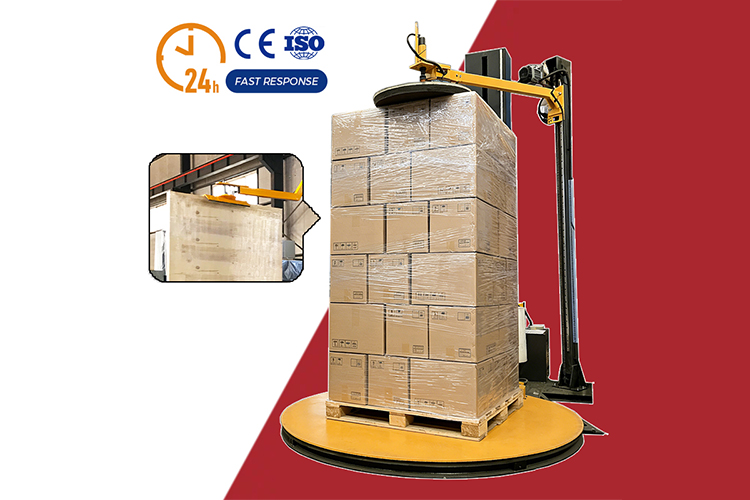
Top Press Pallet Stretch Wrapping Machine
view more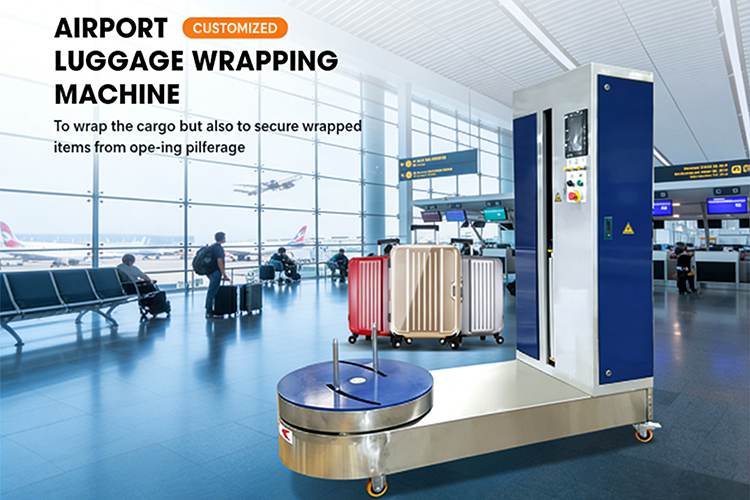
Luggage Wrapping Machine for Airports
view more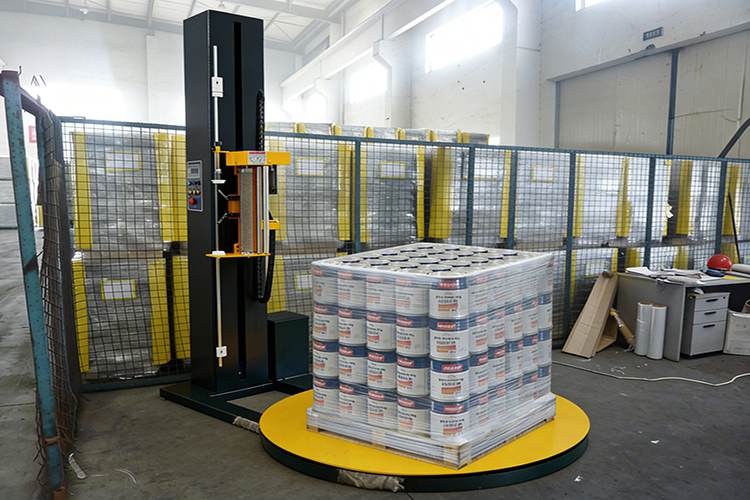
Pallet Stretch Wrapping Machine for Canned Goods
view more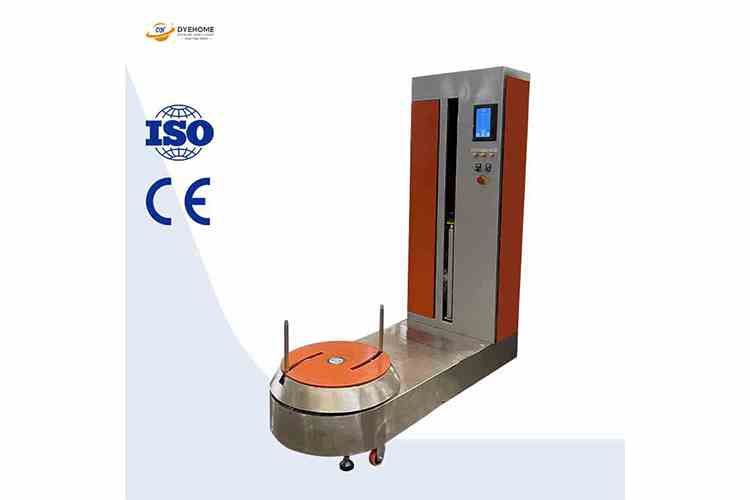
Airport Self-Service Luggage Wrapping Machine
view more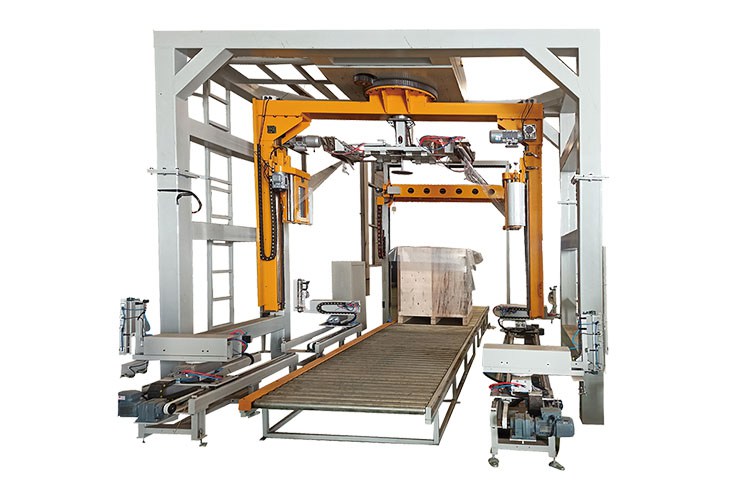
Cantilever wrapping film packaging machine
view more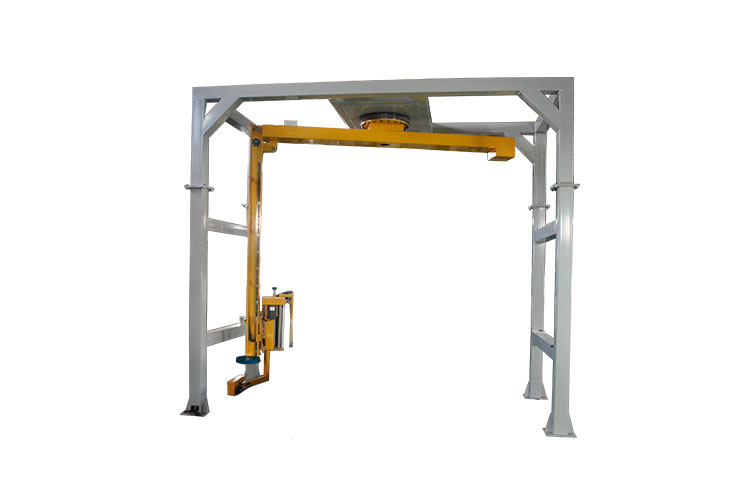
Gantry fully automatic cantilever wrapping machine
view more
 Shandong Dyehome Intelligent Equipment Co.,Ltd
Phone:0086-17362172587
Whatsapp:+8617362172587
Email:machinedyehome@gmail.com
Add:Building 62, 3000 Meili East Road, DmiPark, Wujiapu Street, Huaiyin District, Jinan City,Shandong Province
Jinan Jiasen Packaging Equipment Co., LtdPhone:0086-15665802370
Add:High-end Equipment Manufacturing Industrial Park, East Industrial New Town, Ancheng Town, Pingyin County, Jinan City, Shandong Province
Shandong Golden Pack Intelligent Equipment Co.,LtdPhone:0086-15662690213
Add:High-end Equipment Manufacturing Industrial Park, East Industrial New Town, Ancheng Town, Pingyin County, Jinan City, Shandong Province
YoursIndustry
OurSolutions
OurServices
OurInformation