

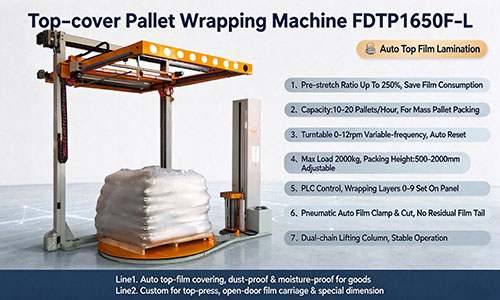
Top-Cover Pallet Wrapping Machine
Top-Cover Pallet Wrapping Machine on the basis of standard pallet wrapping, this machine adds an extra step: after wrapping the four sides of the load, the top-cover unit automatically descends and lays a film layer over the top of the stack. The cargo load is fully enclosed on five sides — the top surface plus four vertical sides. Moisture, rainwater and dust cannot penetrate from the top.
It addresses a specific type of product loss: caking of the top layer of bagged powder materials, rain leakage during sea shipment, and dust and rain exposure for outdoor storage. These damages originate from the top, as standard wrapping machines leave the top open. Extra wrapping cycles on the sides cannot seal the top opening.
Quick Check: Do You Need a Top-Cover Wrapper?
|
Your Scenario |
Recommendation |
|
Bagged powder such as flour, starch, cement, feed and putty powder with frequent top-layer caking |
Top cover required; five-sided sealing is a reliable solution |
|
Cargo for sea export, long-distance transport or mixed loading in containers |
Top cover required; the edge of top film is pressed into side wraps to form a continuous seal |
|
Outdoor or semi-outdoor storage, or shipments during rainy seasons in southern regions |
Top cover required |
|
In-house handling only, with complete carton outer packaging |
No top cover needed; standard pallet wrapper is sufficient to avoid extra cost |
A commonly overlooked point: more film layers do not equal better moisture resistance. Poor overlap on the top will allow ingress regardless of how many side wraps are applied. The core advantage of the top-cover machine is that the top film fully covers the stack top, with edges embedded into side wrapping layers for continuous sealing. This is the fundamental difference compared with manually covering tarpaulins after wrapping.
Standard Specification (FTP1800F-L)
|
Item |
Value |
Remark |
|
Top cover film width |
1600 mm |
Covers the diagonal (approx. 1562 mm) of a 1200×1000 mm pallet with allowance |
|
Turret diameter |
1800 mm |
Larger than standard turret models for stable wrapping |
|
Wrapping size |
(900–1200) × (900–1200) mm |
Customizable for larger dimensions |
|
Packing height |
500–2000 mm |
Customizable extended height available |
|
Load capacity |
2000 kg |
For loads over 2 tons per pallet, refer to rotary arm top-cover models |
|
Throughput |
10–20 pallets/hour |
Including top-cover cycle; slower than standard wrappers but completes five-sided sealing in one run |
|
Auto film cutting & feeding |
Pneumatic control: automatic film feeding, cutting and smoothing |
One full cycle for top cover + side wrapping, no manual intervention |
|
Power / Voltage |
3.7 kW / 380 V |
Three-phase power required for the top-cover mechanism; confirm power supply on site before installation |
|
Machine weight |
900 kg |
— |
|
Air consumption / Air pressure |
1000 ml/min / 0.4–0.6 MPa |
Air source required |
|
Overall dimension |
2900 × 2900 × 3500 mm |
The top-cover assembly requires overhead space; workshop clear height ≥ 4 m is recommended |
|
Optional features |
Accessible film carriage for easy roll change, top press for unstable high stacks, ramp |
— |
How to Select Top-Cover Film Width — Calculated by Pallet Diagonal
1200×1000 mm pallet: diagonal ≈ 1562 mm → 1600 mm top film is suitable with margin
1250×1250 mm pallet: diagonal ≈ 1768 mm → 1600 mm film is insufficient; wider film or custom design required
Provide exact pallet length and width when placing an order. Selecting film width based on pallet diagonal is critical and the most frequent mistake when purchasing this machine.
Working Principle of Five-Sided Sealing
The turret pallet wrapper first wraps the four sides of the load according to preset cycles. A photoelectric sensor detects stack height and triggers the top-cover unit. The lifting mechanism lowers the film carriage to the top of the load. The film roll mounted on the discharge rollers of the lifting frame unwinds film driven by a motor and sprocket system to fully cover the stack top. Once film feeding finishes, the clamping mechanism releases and cuts the film automatically, then the unit resets. The side wrapping layers clamp the edges of the top film to form a continuous five-sided seal covering the top and four sides. The whole cycle runs automatically; one operator can supervise multiple machines.
Applicable Industries
Grain and oil processing for flour, starch and grain powder; building materials and feed including cement and mortar; chemical goods such as coated materials and resin in drums; glass, ceramic, hardware and other cargo requiring dust and moisture protection; all types of export pallet shipments by sea.
Field Reference Case
A flour manufacturer in Shandong ships more than one hundred pallets daily. Previously, shipments to southern distributors during rainy seasons often triggered complaints due to caking on the top layer. After switching to the top-cover model, five-sided sealing effectively reduced moisture-related complaints. On-site staffing dropped from two operators to one inspector.
Suitable & Unsuitable Scenarios
If any condition below applies, this model may not be the optimal choice:
|
Scenario |
Better Option |
Reason |
|
Single load > 2 tons or stack height > 2.4 m |
Rotary arm wrapping machine with optional top cover |
Turret rotation may cause load collapse for heavy and tall stacks; rotary arm keeps cargo stationary |
|
Four-way strapping + five-sided sealing for export |
Integrated wrap-strap-top-cover machine |
Completes wrapping, strapping and top covering in one cycle |
|
Daily output over 100 pallets or integration with conveyor lines |
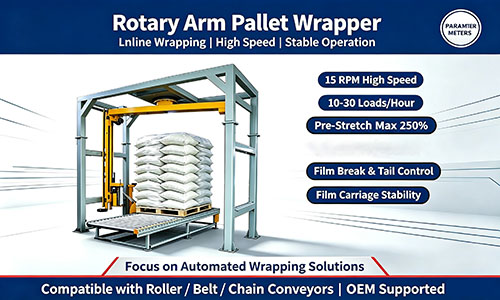
Inline wrapping machine with optional top cover |
Bottleneck lies in manual loading/unloading |
|
Dust containment and load stability only, no moisture requirement |
Standard TP series pallet wrapper |
Avoid extra cost for unnecessary top-cover function |
FAQ
Q: Is the top-cover machine worth the extra cost compared with a standard wrapper plus manual tarpaulin covering? A: Two angles for cost evaluation. Efficiency: manual tarpaulin application takes extra time per pallet and creates bottlenecks during peak shipping; tarpaulins easily shift and fall off in transit, leaving no reliable protection. Performance: tarpaulins are loose with gaps. The machine-laid top film conforms to the stack profile and is locked into side wraps for a continuous seal. For powder factories with large daily shipments, the machine usually pays for itself through reduced cargo loss within one rainy season.
Q: Is the 1600 mm top cover film wide enough for my pallet? A: Measure the pallet diagonal. 1200×1000 mm has a diagonal of approx. 1562 mm and fits; 1250×1250 mm has a diagonal of approx. 1768 mm and does not fit, requiring wider film or customization. Send us your pallet dimensions for calculation.
Q: How much slower is it than a standard wrapper? A: This model runs at 10–20 pallets/hour, while standard turret wrappers reach 20–40 pallets/hour. The speed difference comes from the extra lifting, film feeding and cutting actions in each cycle. If five-sided sealing is mandatory, eliminating manual top covering often improves overall line tact time despite the slower wrapping cycle.
Q: Can it connect to production lines? A: Yes. The top-cover version can be configured as inline equipment with conveyor interfacing and signal communication. For daily volumes above 100 pallets in production lines, refer to inline top-cover wrapping machines.

 Shandong Dyehome Intelligent Equipment Co.,Ltd
Phone:0086-17362172587
Whatsapp:+8617362172587
Email:machinedyehome@gmail.com
Add:Building 62, 3000 Meili East Road, DmiPark, Wujiapu Street, Huaiyin District, Jinan City,Shandong Province
Jinan Jiasen Packaging Equipment Co., LtdPhone:0086-15665802370
Add:High-end Equipment Manufacturing Industrial Park, East Industrial New Town, Ancheng Town, Pingyin County, Jinan City, Shandong Province
Shandong Golden Pack Intelligent Equipment Co.,LtdPhone:0086-15662690213
Add:High-end Equipment Manufacturing Industrial Park, East Industrial New Town, Ancheng Town, Pingyin County, Jinan City, Shandong Province
YoursIndustry
OurSolutions
OurServices
OurInformation